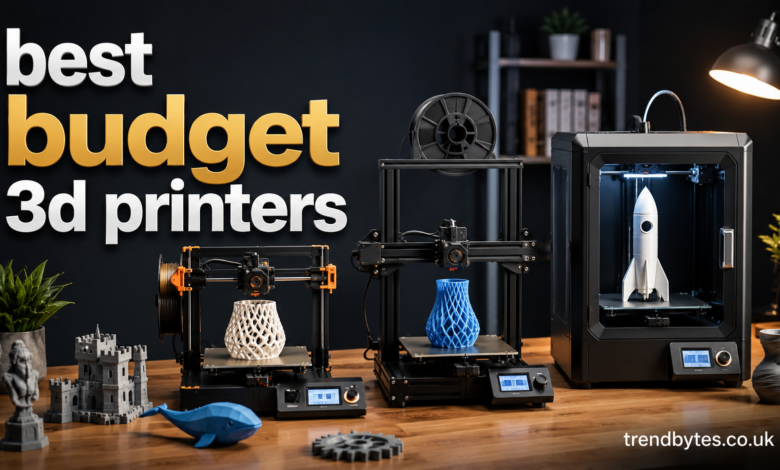
Finding the best budget 3D printers is easier when you know which features actually matter. You do not need to spend a huge amount of money to start creating useful models, replacement parts, prototypes, decorations, toys, and practical household items.
Today’s affordable 3D printers can offer features that were once limited to more expensive machines, including automatic bed leveling, flexible print surfaces, fast printing, direct-drive extruders, and improved user interfaces.
However, the cheapest printer is not always the best value. A low purchase price can become expensive if the machine is difficult to set up, requires constant repairs, or produces unreliable prints.
This guide explains what to look for, which features matter most, who budget 3D printers are best for, common mistakes to avoid, and how to choose a machine that fits your needs.
What Are the Best Budget 3D Printers?
The best budget 3D printers balance price, print quality, reliability, ease of use, and available features.
For beginners, a printer that works consistently can be more valuable than one with a long list of advanced specifications.
A good affordable printer should ideally provide:
- Reliable extrusion
- Automatic or assisted bed leveling
- A stable print platform
- Good layer consistency
- Easy filament loading
- A heated print bed
- A reasonable build volume
- Simple controls
- Accessible replacement parts
- Useful safety features
- Compatibility with common slicer software
The right combination depends on what you plan to print.
Someone making small decorative models has different needs from a hobbyist printing functional mechanical parts.
Why Buy a Budget 3D Printer?
3D printing has become much more accessible because entry-level machines can now handle many common projects.
A budget printer can be useful for students, hobbyists, DIY enthusiasts, educators, artists, and people who simply want to experiment with making physical objects.
For example, you could use one to create cable organizers, phone stands, storage accessories, tabletop gaming pieces, replacement knobs, custom brackets, or educational models.
The biggest advantage is the ability to turn a digital design into a physical object without needing expensive manufacturing equipment.
What Should You Look for in a Budget 3D Printer?
Price should be only one part of your decision.
Print Quality
Print quality depends on many factors, including mechanical stability, extrusion control, calibration, slicer settings, filament quality, and printer design.
A printer with excellent specifications can still produce poor results if it is difficult to calibrate.
Look for a machine known for consistent first layers and reliable extrusion rather than focusing only on maximum advertised resolution.
Build Volume
Build volume determines the maximum size of the object you can print in one piece.
A smaller build area can be perfectly adequate for miniatures, small tools, decorations, and household accessories.
If you expect to print larger models, furniture components, helmets, cosplay pieces, or large prototypes, consider a printer with a larger build volume.
However, larger machines usually require more desk space and may cost more.
Automatic Bed Leveling
Bed leveling is one of the most important features for beginners.
If the print surface is not properly positioned relative to the nozzle, the first layer can fail. This may cause poor adhesion, uneven surfaces, or completely failed prints.
Automatic or assisted leveling can reduce the amount of manual adjustment required.
It does not eliminate the need for proper setup, but it can make the learning process much easier.
Heated Print Bed
A heated bed can improve adhesion and help reduce certain types of warping.
This is particularly useful when printing materials that require controlled temperatures.
For beginners using common materials such as PLA, a heated bed also makes the printing process easier and more consistent.
Extruder Design
The extruder pushes filament toward the hot end where it is melted and deposited layer by layer.
Direct-drive systems can be useful for flexible materials because the filament travels a shorter distance before reaching the nozzle.
Bowden-style systems can also work well and may reduce moving mass on certain printer designs.
Neither system is automatically better for every user. Your choice should depend on the materials you plan to print.
Best Budget 3D Printers for Beginners
Beginners should prioritize simplicity.
A good starter machine should be relatively easy to assemble, calibrate, load with filament, and operate.
Features such as automatic bed leveling, a flexible build surface, straightforward controls, and a clear interface can make the first few weeks much less frustrating.
Avoid buying a highly complicated machine simply because it offers more features.
If you are printing your first model, reliability and ease of use are often more important than advanced customization options.
Expert Tip for First-Time Buyers
Before purchasing, search for information about replacement nozzles, build plates, fans, belts, and other common parts.
A printer can be inexpensive to purchase but difficult to maintain if replacement components are difficult to find.
Good parts availability can save you money and frustration later.
FDM vs. Resin 3D Printers
One of the first decisions you need to make is choosing between FDM and resin printing.
FDM 3D Printers
FDM printers melt filament and deposit it layer by layer.
They are popular for:
- Household parts
- Prototypes
- Tools
- Large models
- Educational projects
- Cosplay pieces
- Functional components
FDM is often the better starting point for general-purpose home printing because filament is relatively straightforward to store and handle.
Resin 3D Printers
Resin printers use liquid resin and light to create highly detailed objects.
They are especially useful for:
- Miniatures
- Figurines
- Detailed models
- Jewelry prototypes
- Small decorative pieces
However, resin printing requires additional safety precautions, cleaning, curing, ventilation considerations, and consumables.
For someone who wants a simple first printer for general household projects, FDM is often the more practical starting point.
Which Filament Should You Use?
The material you choose can have a major impact on your printing experience.
PLA
PLA is one of the easiest materials for beginners.
It is commonly used for models, decorations, prototypes, educational projects, and many household objects.
It generally prints at relatively accessible temperatures and is widely available.
PETG
PETG offers a useful balance between ease of printing and durability.
It can be a good choice for functional parts that need more toughness than typical PLA prints.
However, it may require more careful settings than PLA.
ABS
ABS can provide useful mechanical properties, but it is generally more demanding to print.
Warping, temperature control, ventilation, and enclosure considerations can become important.
It is usually better suited to users who already understand basic 3D printing.
TPU
TPU is a flexible filament that can be used for items such as grips, seals, protective covers, and flexible accessories.
Flexible filament can be more challenging to print, so beginners may want to master PLA first.
How Much Should You Spend on a Budget 3D Printer?
There is no universal budget because prices and features vary by market.
Instead of choosing an arbitrary price limit, decide which features you need.
For a beginner, it can be worth spending slightly more for reliable bed leveling, a good build surface, a stable frame, and easy maintenance.
A machine that costs a little more but saves hours of troubleshooting can offer better value over time.
Also remember to budget for filament, replacement nozzles, tools, storage, and potentially spare components.
The printer is only part of the total cost of the hobby.
Common Uses for Affordable 3D Printers
Budget 3D printers can be surprisingly useful.
Home Organization
You can print drawer dividers, cable clips, hooks, holders, and storage accessories.
DIY Repairs
If a plastic component breaks and a replacement is unavailable, you may be able to design and print a replacement.
Education
Students can create models of geometric shapes, mechanical systems, architectural structures, scientific concepts, and historical objects.
Gaming
3D printing is popular for tabletop accessories, terrain, organizers, and custom gaming components.
Prototyping
Small businesses and hobbyists can quickly create physical versions of product ideas before investing in larger-scale manufacturing.
How to Get Better Results From a Budget 3D Printer
Even an affordable printer can produce excellent results when properly maintained.
Start by calibrating the machine carefully.
Make sure the print surface is clean and properly positioned. Use the recommended temperature range for your filament and adjust settings gradually.
Do not immediately increase printing speed to the maximum advertised level.
Higher speed can affect surface quality, dimensional accuracy, and reliability.
Instead, start with conservative settings and increase speed only after you understand how the printer responds.
Best Practices for 3D Printing
A few simple habits can make a major difference.
Keep filament dry when the material is sensitive to moisture. Store it in an appropriate sealed container when necessary.
Clean the build surface regularly.
Inspect belts, screws, fans, and other moving components from time to time.
Keep the nozzle clean and replace it when wear begins to affect print quality.
Also, learn how your slicer works. Slicer settings control many aspects of the final print, including layer height, infill, supports, temperatures, and speed.
Understanding these settings gives you much more control than simply pressing the print button.
Common Mistakes to Avoid
Buying Only Based on Price
The cheapest machine is not necessarily the best value.
Reliability, support, replacement parts, and ease of maintenance should also influence your decision.
Ignoring Build Volume
Buying a printer that is too small for your projects can become frustrating quickly.
Think about the largest objects you realistically expect to print.
Printing Too Fast
Maximum speed specifications do not always represent the best speed for high-quality prints.
Start slowly and optimize from there.
Using Poor-Quality Filament
Inconsistent filament diameter or moisture can create extrusion problems and unreliable results.
Skipping Bed Preparation
A poor first layer can ruin an otherwise successful print.
Take time to prepare and level the print surface.
Ignoring Safety
Hot surfaces, moving components, heated materials, and certain printing materials require appropriate care.
Always follow the manufacturer’s safety instructions and use suitable ventilation and handling practices for the material and printer you are using.
Budget 3D Printer Maintenance Tips
Regular maintenance can extend the useful life of your printer.
Check the machine periodically for loose screws and fasteners.
Keep the build surface clean and inspect it for damage.
Make sure belts have appropriate tension and that moving components operate smoothly.
Keep the nozzle and extrusion path free of buildup.
If you notice unusual sounds, inconsistent layers, or repeated failures, investigate the problem instead of continuing to print without addressing it.
A few minutes of maintenance can prevent larger problems later.
How to Choose the Right Printer for Your Needs
Start with your intended projects.
If you want to print basic models and household accessories, a straightforward FDM printer is likely enough.
If you need highly detailed miniatures, consider a resin machine.
If you want large functional parts, prioritize build volume and mechanical stability.
If you are new to 3D printing, prioritize automatic leveling, easy maintenance, strong community support, and accessible replacement parts.
Finally, think about your workspace. A printer needs enough room for operation, ventilation where appropriate, filament storage, and maintenance.
People Also Ask About the Best Budget 3D Printers
What is the best budget 3D printer for beginners?
The best budget printer for a beginner should offer reliable printing, easy setup, automatic or assisted leveling, a heated bed, accessible replacement parts, and straightforward controls.
Are cheap 3D printers worth buying?
Yes, affordable 3D printers can be worth buying when they provide a good balance of reliability, print quality, maintenance, and features. Extremely cheap machines may require more troubleshooting.
What is the easiest 3D printer to use?
Ease of use depends on the printer design, but beginners generally benefit from automatic bed leveling, a simple interface, reliable filament loading, and a removable build surface.
Is FDM or resin better for beginners?
FDM is often more practical for beginners who want general-purpose printing. Resin is excellent for highly detailed models but requires additional cleaning, curing, handling, and safety precautions.
What is the best filament for beginners?
PLA is usually one of the easiest materials for beginners because it is widely available and relatively straightforward to print.
How much should I spend on a budget 3D printer?
The appropriate budget depends on your required features and local market. Focus on overall value rather than selecting a printer solely because it has the lowest purchase price.
Can a budget 3D printer make good-quality prints?
Yes. Print quality depends on the printer’s mechanical design, calibration, filament, slicer settings, and maintenance. An affordable printer can produce excellent results when properly configured.
What can you make with a cheap 3D printer?
You can make organizers, brackets, holders, prototypes, educational models, decorations, gaming accessories, replacement parts, and many other objects. The practical possibilities depend on the printer’s build volume and materials.
Final Thoughts on the Best Budget 3D Printers
Choosing the best budget 3D printers is about finding the right balance between cost, reliability, features, and your intended projects.
For most beginners, a dependable FDM printer with automatic or assisted bed leveling, a heated bed, a stable build platform, and good parts availability is a strong starting point. PLA is also an easy material for learning the basics.
More advanced users may need larger build volumes, stronger materials, flexible filament support, or resin printing for detailed models.
Before buying, consider what you actually want to create, how much space you have, which materials you plan to use, and how comfortable you are with maintenance.
The best budget 3D printer is not simply the cheapest machine available. It is the printer that gives you reliable results, manageable maintenance, useful features, and enough capability to support your projects as your skills grow.