What Is Latency vs Bandwidth? Understanding the Key Differences

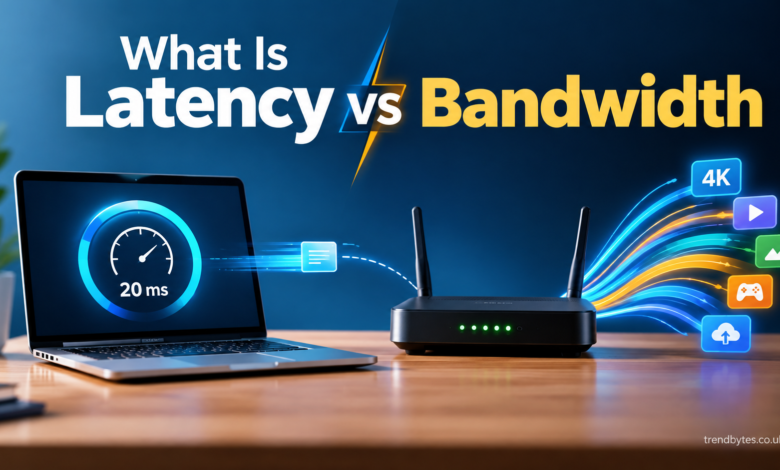
If you have ever wondered what is latency vs bandwidth, you are not alone. These two networking terms are often used when people talk about internet speed, but they describe very different things. Bandwidth is about how much data a connection can handle, while latency is about how long data takes to travel from one point to another.
Understanding the difference can help you choose the right internet plan, troubleshoot slow connections, improve gaming performance, and understand why a connection with high download speeds can still feel sluggish.
In this guide, we will explain latency and bandwidth in simple terms, compare them directly, look at real-world examples, and explain when each one matters most.
What Is Latency vs Bandwidth?
The easiest way to understand what is latency vs bandwidth is to think about a highway.
Bandwidth is similar to the number of lanes on the highway. More lanes allow more vehicles to travel at the same time.
Latency is similar to the time it takes for one vehicle to travel from one location to another. Even if a highway has many lanes, a long travel distance can still result in a longer trip.
In networking:
- Bandwidth measures how much data can be transferred over a connection during a given period.
- Latency measures the delay before data begins reaching its destination.
- Bandwidth is commonly measured in Mbps or Gbps.
- Latency is usually measured in milliseconds (ms).
A connection can have high bandwidth but high latency, or lower bandwidth but very low latency.
What Is Bandwidth?
Bandwidth refers to the maximum amount of data a network connection can transfer over a specific period.
For example, an internet connection advertised at 500 Mbps has considerably more capacity than one offering 50 Mbps.
However, bandwidth does not automatically tell you how quickly a single request will receive a response. It tells you how much information the connection can potentially handle.
How Bandwidth Affects Internet Performance
Higher bandwidth can be useful when multiple devices or applications are transferring large amounts of data.
For example, a household might have:
- Several people watching HD or 4K video
- Computers downloading large files
- Phones backing up photos
- Smart TVs and security cameras using the network
- Someone playing an online game
A higher-bandwidth connection gives the network more capacity to handle these activities simultaneously.
A Simple Bandwidth Example
Imagine a water pipe.
A wider pipe can carry more water at the same time. Similarly, greater network bandwidth allows more data to be transferred during a given period.
But a wider pipe does not necessarily mean the water arrives instantly. That part is closer to the concept of latency.
What Is Latency?
Latency is the amount of time it takes for data to travel between two points on a network.
It is commonly measured in milliseconds.
For example, if a network test shows a ping of 20 ms, the round-trip communication delay is relatively low. If it shows 200 ms, the delay is much more noticeable for interactive applications.
Latency can come from several sources, including:
- Physical distance
- Network congestion
- Routing paths
- Network equipment
- Wireless interference
- Server location
- Processing delays
Why Latency Matters
Latency is especially important when applications require quick back-and-forth communication.
This includes:
- Online gaming
- Video conferencing
- Voice calls
- Remote desktop access
- Financial trading systems
- Cloud applications
- Interactive websites
- Live collaboration tools
For these activities, reducing delay can make a connection feel much more responsive.
What Is Latency vs Bandwidth in Real-World Use?
The difference becomes easier to understand with practical examples.
Suppose you have two internet connections:
Connection A: 1 Gbps bandwidth with 100 ms latency
Connection B: 200 Mbps bandwidth with 20 ms latency
Connection A has much greater capacity. However, Connection B may feel more responsive during an online game or video call because its latency is significantly lower.
On the other hand, Connection A could be better for downloading large files or supporting many simultaneous high-bandwidth activities.
This shows why internet performance is not determined by bandwidth alone.
Latency vs Bandwidth: Key Differences
| Feature | Latency | Bandwidth |
|---|---|---|
| What it measures | Delay | Data capacity |
| Common unit | Milliseconds (ms) | Mbps or Gbps |
| Lower or higher is better? | Lower | Higher |
| Important for gaming? | Very important | Moderately important |
| Important for streaming? | Moderate | Very important |
| Affects responsiveness? | Yes | Indirectly |
| Affects simultaneous users? | Less directly | Strongly |
| Main concern | How quickly data responds | How much data can move |
The key takeaway is simple: latency is about delay, while bandwidth is about capacity.
How Latency and Bandwidth Work Together
Latency and bandwidth are different, but they can affect your overall network experience together.
Imagine downloading a large 10 GB file.
High bandwidth can significantly improve the transfer rate once data begins flowing. But latency can affect how quickly communication between your device and the remote server happens.
For large transfers, bandwidth often becomes more important after the connection is established.
For short, interactive requests, latency can matter more.
Low Latency With High Bandwidth
This is generally an ideal combination.
You get:
- Fast data transfer
- Responsive applications
- Smooth video calls
- Better gaming responsiveness
- Strong performance with multiple devices
Fiber internet often provides a strong combination of high bandwidth and relatively low latency, although actual performance depends on the provider, network design, routing, and server location.
High Bandwidth With High Latency
This combination can be misleading.
You might see an impressive speed-test result, yet applications can still feel delayed.
For example, a connection could download large files quickly but have noticeable delays when connecting to a distant gaming server.
Low Bandwidth With Low Latency
This connection may feel responsive but struggle with heavy data usage.
A web page might respond quickly, but multiple 4K streams or large downloads could overwhelm the available capacity.
How Latency Affects Online Gaming
For gamers, latency is often more important than having extremely high bandwidth.
When you play an online multiplayer game, your device constantly exchanges information with the game server.
Low latency means commands and updates can travel with less delay.
High latency can cause:
- Delayed responses
- Character movement appearing behind your inputs
- Lag
- Rubber-banding
- Difficulty reacting quickly
- Poor multiplayer experiences
A very high download speed cannot completely eliminate these problems if the connection to the game server has high latency.
What Is a Good Gaming Latency?
There is no single perfect number because gaming performance depends on the game and network.
As a general guideline:
- Under 20 ms: Excellent
- 20–50 ms: Very good
- 50–100 ms: Usually acceptable
- 100–150 ms: Noticeable in fast-paced games
- 150+ ms: Often problematic for competitive gaming
These are practical guidelines rather than strict rules.
How Bandwidth Affects Streaming
Streaming services generally depend heavily on bandwidth.
Higher-quality video requires more data to be delivered continuously.
For example, 4K streaming generally requires considerably more bandwidth than standard-definition video.
If your available bandwidth is too low, you may experience:
- Buffering
- Reduced video quality
- Longer loading times
- Interrupted playback
However, extremely high bandwidth does not guarantee perfect streaming if there is severe packet loss, congestion, or an unstable connection.
How Latency Affects Video Calls
Video calls need both sufficient bandwidth and reasonably low latency.
Bandwidth determines whether your connection can carry the audio and video data reliably.
Latency affects how quickly participants receive each other’s communication.
High latency can lead to:
- Awkward pauses
- People talking over one another
- Delayed responses
- Audio arriving after video
- Poor conversational flow
For meetings, low latency can make communication feel much more natural.
How to Test Latency and Bandwidth
You can evaluate both metrics using an internet speed test.
A typical test may report:
- Download speed
- Upload speed
- Ping or latency
- Sometimes jitter
- Sometimes packet loss
Do not focus only on download speed.
If your internet feels slow despite having a fast plan, check latency, upload performance, Wi-Fi signal quality, and network congestion as well.
Testing at different times can also reveal whether performance changes during busy periods.
Common Mistakes to Avoid
Mistake 1: Assuming More Bandwidth Means Lower Latency
Buying a faster internet plan does not automatically reduce latency.
Your latency can depend on the physical distance to the server, routing, network equipment, and other factors.
Mistake 2: Looking Only at Download Speed
Download speed is only one part of network performance.
For video calls, gaming, uploading content, and cloud backups, upload speed and latency can also matter.
Mistake 3: Confusing Ping With Bandwidth
Ping is commonly used as a practical measurement of network response time.
It does not measure how much data your internet connection can transfer.
Mistake 4: Ignoring Wi-Fi Conditions
A fast internet plan can perform poorly over a weak or congested Wi-Fi connection.
Distance from the router, interference, walls, and competing wireless devices can all affect performance.
Mistake 5: Assuming Every Problem Is Your ISP
Sometimes the problem is the destination server rather than your internet connection.
A website or game server may be overloaded, geographically distant, or connected through an inefficient route.
Expert Tips for Improving Network Performance
If you want a better overall connection, consider both bandwidth and latency.
Use Ethernet when possible. A wired connection can provide more consistent performance than Wi-Fi, especially for gaming and desktop video calls.
Choose a router that fits your needs. Older or poorly positioned equipment can become a bottleneck.
Reduce unnecessary network traffic. Large downloads, cloud backups, and multiple high-resolution streams can consume available bandwidth.
Choose nearby servers when possible. A geographically closer server often provides lower latency, although routing can affect the actual result.
Check latency during the problem. If your connection has plenty of bandwidth but applications remain slow, latency, packet loss, or congestion may be worth investigating.
Consider network congestion. Performance can decline when many devices or users compete for the same connection.
Which Matters More: Latency or Bandwidth?
There is no universal answer.
It depends on what you are doing.
For online gaming, latency is usually more important.
For 4K streaming, bandwidth is generally more important.
For video conferencing, both matter.
For large file downloads, bandwidth usually has a greater impact.
For web browsing, both can contribute to the experience, especially when pages require many separate network requests.
For remote desktop applications, low latency can be particularly valuable because every interaction requires communication between your device and another system.
The best connection balances adequate bandwidth with low and stable latency.
People Also Ask
Is latency the same as internet speed?
No. Latency measures network delay, while bandwidth measures how much data a connection can transfer over time. A connection can have high bandwidth and still experience high latency.
Is lower latency better?
Yes. Lower latency generally means less delay between sending data and receiving a response. This is particularly useful for gaming, calls, remote work, and other interactive applications.
Is higher bandwidth always better?
Higher bandwidth provides greater data capacity, but it is not always necessary. A household with a few light internet users may not benefit much from extremely high bandwidth.
Does higher bandwidth reduce ping?
Not necessarily. Increasing your internet plan’s bandwidth does not automatically reduce ping. Ping depends on factors such as routing, distance, congestion, and network technology.
What is more important for gaming, latency or bandwidth?
Latency is generally more important for responsive online gaming. Most modern games do not require extremely high bandwidth, but high latency can make gameplay feel delayed.
What is more important for Netflix, latency or bandwidth?
Bandwidth is usually more important for video streaming because high-resolution content requires a steady flow of data. However, latency and connection stability can still affect the initial connection and overall experience.
Can you have low latency and low bandwidth?
Yes. A connection can respond quickly but have limited capacity. It may feel responsive for basic browsing while struggling with large downloads or multiple high-quality video streams.
Why is my internet fast but still laggy?
Your connection may have high latency, packet loss, congestion, Wi-Fi interference, or routing problems. A high download speed alone does not guarantee a responsive network.
Conclusion: What Is Latency vs Bandwidth?
So, what is latency vs bandwidth? The simplest answer is that latency measures delay, while bandwidth measures data capacity.
Think of bandwidth as the number of lanes on a highway and latency as the travel time between two locations. More lanes allow more traffic to move at once, but they do not necessarily make the destination closer.
Both metrics play important roles in network performance. Gamers and people using interactive applications often benefit greatly from low latency, while households streaming high-quality video or transferring large files may need more bandwidth.
When evaluating an internet connection, don’t look at download speed alone. Consider bandwidth, latency, upload speed, stability, packet loss, Wi-Fi quality, and the location of the servers you use most.
The best network is not simply the one with the biggest advertised speed. It is the one that provides enough bandwidth for your workload while keeping latency and connection instability low.