Escape Room Board Games at Home: How to Create an Amazing Game Night

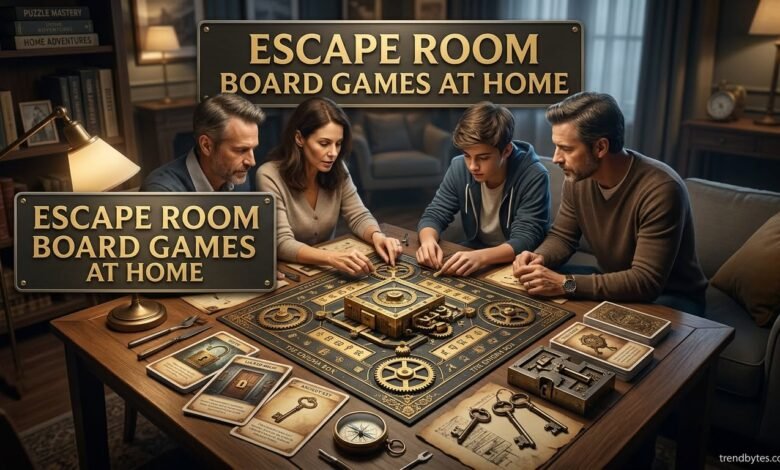
Escape room board games at home are an easy way to turn an ordinary evening into a team-based adventure. Instead of traveling to a physical escape room, players can solve clues, decode messages, unlock puzzles, and complete a mystery from the comfort of their living room.
These games are especially popular for families, couples, friends, and small groups who enjoy puzzles but want something more structured than a traditional board game. Many versions combine storytelling, hidden information, logic puzzles, cards, codes, and timed challenges.
The best part is that you do not need a dedicated game room. With the right game, a table, a few players, and some uninterrupted time, you can create an engaging escape-room experience almost anywhere.
What Are Escape Room Board Games at Home?
Escape room board games are tabletop games designed around the basic concept of a real escape room.
Players usually work together to complete a scenario or solve a mystery. Instead of physically escaping a locked room, the goal may be to discover a hidden password, solve a crime, stop a disaster, find an object, or complete a sequence of puzzles.
Most games provide a combination of:
- Puzzle cards
- Clue cards
- Story documents
- Maps or illustrations
- Codes and symbols
- Envelopes or hidden components
- A timer or suggested playing time
- Instructions and a final solution
The exact format varies considerably.
Some games are reusable, while others are designed as one-time experiences because players write on cards, open sealed materials, or permanently alter components.
Why Escape Room Games Are Great for Home Game Night
Traditional board games can be competitive, but escape-room games often create a different kind of experience.
Everyone is working toward the same goal.
That cooperative structure can make the game particularly enjoyable for groups where players have different strengths.
One person might notice visual patterns quickly, while another may be better at word puzzles. Someone else might naturally organize clues and track information.
Escape Room Board Games at Home Encourage Teamwork
Communication is one of the most important skills in an escape game.
Players need to explain what they have discovered, share possible solutions, and decide which clue deserves attention.
This can create memorable moments because solving a difficult puzzle together often feels more rewarding than simply winning a competitive game.
They Work Well for Different Group Sizes
Some games are designed for two players, while others work better with larger groups.
Before buying or starting a game, check the recommended player count.
A complicated game designed for six people may feel overwhelming with two players, while a simple two-player mystery might not give a large group enough to do.
Types of Escape Room Board Games to Try
Not every escape game offers the same experience.
Choosing the right type can make a major difference.
Mystery-Based Escape Games
These games focus on solving a crime, discovering a secret, or identifying a culprit.
Players usually examine documents, clues, character information, and evidence.
Mystery games are a strong choice for adults and older teens who enjoy detective stories.
Adventure Escape Games
Adventure games usually involve exploration and a larger story.
Players might be searching for treasure, escaping a dangerous location, exploring an ancient site, or trying to prevent an event.
These games are often a good choice for families because the story can make puzzles feel more exciting.
Horror and Suspense Games
Some escape-room games use darker themes, suspense, or supernatural stories.
These can be excellent for Halloween parties or late-night game sessions.
However, always check the recommended age range and theme before choosing one for younger players.
Family-Friendly Puzzle Games
Family-oriented games usually use easier logic puzzles and simpler instructions.
They can be a good introduction for children who have never played an escape-room game.
For younger children, adults may need to read instructions or provide hints.
How to Set Up Escape Room Board Games at Home
You do not need an elaborate setup.
Start by choosing a comfortable table with enough space for all players to see the cards and puzzle materials.
Put phones and other distractions away if everyone agrees to focus on the game.
Then read the instructions carefully before beginning.
Create a Simple Atmosphere
Lighting can influence the experience.
For a mystery game, softer lighting and background music can make the room feel more immersive.
For a family game, simply keeping the table organized may be enough.
Do not overcomplicate the setup. The puzzles and story should remain the main focus.
Set a Time Limit
Many escape games are designed to be completed within a specific period.
Using a timer can add excitement and encourage players to make decisions instead of spending too long on one puzzle.
However, if children or beginners are playing, consider treating the timer as a suggestion rather than a strict rule.
How to Play an Escape Room Board Game Successfully
The biggest mistake new players make is trying to solve everything individually.
Instead, divide the work.
If you have several clues, spread them across the table so everyone can inspect different pieces.
One player can look for patterns while another checks written clues.
Communicate Every Discovery
Even a clue that seems unimportant could become useful later.
Say what you find out loud.
For example, if one player notices that several numbers appear repeatedly, another player might realize that those numbers correspond to a code.
Good communication prevents players from accidentally working on the same problem while another clue is being ignored.
Keep Clues Organized
Create separate areas for:
- Unsolved clues
- Solved clues
- Important information
- Items that still need investigation
This simple system can prevent confusion during a complicated game.
What to Do When You Get Stuck
Getting stuck is completely normal.
Escape games are designed to challenge players, and some puzzles may require several attempts.
The first step is to take a short break from the puzzle.
Look at the information again with fresh eyes.
Sometimes the solution becomes obvious after stepping away for a few minutes.
Use Hints Strategically
Many escape-room board games provide hints.
Using one does not mean you failed.
A good hint system is designed to keep the game moving without immediately revealing the answer.
If your group has spent ten minutes staring at the same clue, a hint may make the experience more enjoyable rather than less challenging.
Best Escape Room Board Game Experience for Different Players
The best game depends on who is playing.
For Families
Choose games with accessible rules, colorful components, and moderate puzzle difficulty.
Avoid games that depend heavily on advanced math or complicated wordplay if young children are participating.
For Couples
Two-player escape games can create an excellent date-night activity.
Choose a story that both players enjoy and make sure the difficulty is appropriate.
A smaller player count can also make every discovery feel more important because both people are actively involved.
For Friends
Larger groups can benefit from games containing several puzzles that can be solved simultaneously.
This prevents everyone from waiting while one person works through a single challenge.
For Experienced Puzzle Fans
Experienced players may want more complex games with layered clues, unusual mechanisms, and fewer obvious solutions.
If your group regularly plays escape games, look for advanced difficulty ratings.
Common Mistakes to Avoid
One common mistake is opening or examining materials before the instructions tell you to do so.
In many escape games, information is revealed in a specific order. Looking ahead can accidentally spoil the experience.
Another mistake is allowing one person to control the entire game.
Even if that player is good at puzzles, everyone should have an opportunity to contribute.
A third mistake is ignoring the story.
Story details often contain clues. Names, dates, symbols, locations, and objects may become important later.
Expert Tips for Better Escape Room Game Nights
Before starting, make sure everyone understands the rules.
Choose one person to read the introduction aloud if the game includes a story.
Next, spread the starting materials across the table.
Avoid stacking everything into one pile because players may miss important information.
It can also help to assign a person to track time.
Most importantly, encourage players to explain their thinking.
A strange idea that seems incorrect at first may lead another player to the correct solution.
How to Make Your Own Escape Room at Home
You can also create a homemade escape experience.
Start with a simple story.
For example, imagine that players have 45 minutes to find a missing key before a fictional museum exhibit is permanently locked.
Then create several connected puzzles.
You could hide a number inside a word puzzle, use that number as a combination, and place the next clue behind the corresponding envelope.
Build a Simple Puzzle Chain
A basic structure could look like this:
- Players discover a coded message.
- The message reveals a three-digit number.
- The number opens an envelope.
- The envelope contains a map.
- The map reveals a hidden word.
- The word unlocks the final clue.
The goal is not to make every puzzle extremely difficult.
A well-designed escape game should feel challenging but solvable.
Escape Room Games vs. Traditional Board Games
Escape games differ from traditional board games because the experience is usually more focused on discovery and cooperation.
A traditional strategy game may be replayed dozens of times because its rules create different outcomes.
Many escape games are more story-driven.
Once you know the solutions, replay value can be limited.
However, that does not necessarily make them less valuable.
For many players, the excitement comes from experiencing the mystery for the first time.
People Also Ask About Escape Room Board Games at Home
What are escape room board games?
Escape room board games are cooperative tabletop games where players solve puzzles, decode clues, and complete a story-based challenge without visiting a physical escape room.
Can you play escape room board games at home?
Yes. Most are specifically designed for home play and require only the game’s components, a suitable table, and the recommended number of players.
How many people can play an escape room board game?
The ideal group size depends on the specific game. Some work well with two players, while others are designed for four, six, or more participants.
Are escape room board games good for families?
Yes. Family-friendly escape games can be an entertaining way to encourage teamwork, communication, logic, and problem-solving. Always check the recommended age range.
Are escape room board games reusable?
It depends on the game. Some are fully reusable, while others contain components that are written on, opened, or altered during play.
How long do home escape room games take?
Many games can be completed in roughly one to two hours, although the actual time depends on the game’s design, difficulty, and players’ experience.
What should you do if you cannot solve an escape game puzzle?
Review the clues, organize the information, communicate with your team, and use the game’s hint system if available. Taking a short break can also help.
Can I make my own escape room game at home?
Absolutely. You can create a simple story and connect several puzzles using codes, hidden messages, envelopes, maps, and clues. Start with a manageable difficulty level.
Conclusion: Making Escape Room Board Games at Home More Fun
Escape room board games at home offer a fun alternative to traditional game nights by combining storytelling, teamwork, puzzles, and problem-solving.
Whether you’re playing with family, friends, a partner, or a group of experienced puzzle fans, the right game can turn an ordinary evening into an engaging adventure.
The key is choosing a game that matches your group’s age, size, and experience level. Once the game begins, keep the clues organized, communicate discoveries, use hints when necessary, and give everyone a chance to contribute.
You can also create your own homemade escape experience with simple codes, hidden messages, envelopes, and connected puzzles.
Ultimately, the best escape room board games at home are not necessarily the hardest ones. They are the games that keep everyone involved, encourage teamwork, and make the final solution feel genuinely rewarding.