3×3 Mini Games: Best Games, Rules, Tips, and Fun Ideas

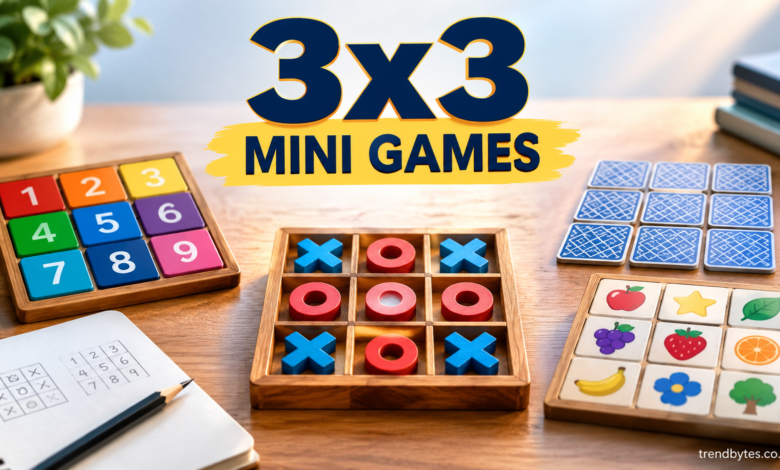
If you enjoy quick, simple challenges, 3×3 mini games are an easy way to have fun without spending hours learning complicated rules. These games usually use a small 3-by-3 grid, making them quick to understand and easy to play on paper, a phone, a computer, or a physical game board.
Some 3×3 games are based on strategy, while others test memory, speed, logic, or creativity. The small playing area is what makes them especially appealing: every move can matter, and a complete round can often be finished in just a few minutes.
Whether you are looking for games to play alone, compete against a friend, or enjoy with family, this guide explains the most popular types, basic strategies, common mistakes, and ways to make 3×3 games more challenging.
What Are 3×3 Mini Games?
3×3 mini games are small games built around a grid containing three rows and three columns. The grid has nine spaces, which creates a compact playing area for different types of challenges.
The best-known example is tic-tac-toe, where two players place Xs and Os on a 3×3 board. However, the format can be used for many other games involving matching, puzzles, numbers, memory, and strategy.
Because the board is small, players can quickly see the entire game state. This makes 3×3 games useful for casual entertainment as well as simple brain-training activities.
Why Are 3×3 Mini Games So Popular?
The biggest advantage is simplicity. Most players can understand a 3×3 game within a few minutes.
They are also convenient. You do not need a large board, special equipment, or a long setup process. A piece of paper and a pencil can be enough.
Another benefit is short playtime. If you have only five or ten minutes, you can still complete several rounds.
Quick Games for Any Age
3×3 mini games can work well for children, teenagers, adults, and families. Simple versions are easy for beginners, while advanced rules can introduce more strategy.
They can also be useful in classrooms or group activities because several players can participate without needing complicated materials.
Best 3×3 Mini Games to Try
There are many ways to use a 3×3 grid. Here are some of the easiest and most entertaining options.
1. Tic-Tac-Toe
Tic-tac-toe is the classic 3×3 game. One player uses X and the other uses O.
Players take turns choosing an empty square. The goal is to place three matching symbols in a horizontal row, vertical column, or diagonal line.
The game ends when someone creates a line or all nine spaces are filled.
Although the rules are simple, playing well requires players to think ahead and watch their opponent’s potential winning moves.
2. 3×3 Number Puzzle
A number puzzle can turn the grid into a quick mathematical challenge.
For example, place numbers from 1 to 9 into the nine spaces and challenge players to create specific sums across rows, columns, or diagonals.
You can change the target number to make the puzzle easier or harder.
This format is particularly useful for people who enjoy logic and mental math.
3. Memory Grid Game
A 3×3 grid can also become a memory challenge.
Place different symbols, letters, or objects in the nine spaces. Give players a few seconds to memorize their positions. Then hide the original arrangement and ask them to recreate it.
For a harder version, increase the number of symbols or reduce the viewing time.
4. Matching Games
Matching games use pairs of symbols or images hidden across a grid.
Players reveal two spaces at a time and try to find matching pairs. If they match, they keep the pair; otherwise, the spaces are covered again.
This version combines memory with concentration and works especially well for younger players.
5. Word Grid Challenges
Instead of numbers or symbols, use letters in each square.
Players can be challenged to create words by connecting letters according to specific rules. You can also give players a category and ask them to identify related words within the grid.
For example, a food-themed grid might contain letters that can be combined into names of fruits, vegetables, or dishes.
How to Play 3×3 Mini Games
The exact rules depend on the game, but the basic process is usually straightforward.
First, create a 3-by-3 grid with nine equal spaces. Next, decide what each player needs to do to win.
For a competitive game, establish turn order before starting. Each player should understand which moves are allowed and how the winner is determined.
Finally, play until someone completes the objective or the board reaches its limit.
The best part is that you can modify the rules once everyone understands the basic version.
Strategies for Winning 3×3 Mini Games
Small boards do not necessarily mean simple strategy. In many games, careful planning can make a major difference.
Control the Center
In games such as tic-tac-toe, the center space can be extremely valuable because it connects with multiple possible winning lines.
If the center is available and strategically important, consider taking it early.
Watch for Two-Way Threats
A two-way threat occurs when your next move could create a winning opportunity in two different places.
This can force your opponent to defend one position while leaving the other open.
Creating these situations is often more effective than simply trying to complete one line immediately.
Think About Your Opponent’s Next Move
Do not focus only on your own strategy.
Before making a move, ask yourself what your opponent could do next. If they are one move away from winning, blocking them should usually take priority.
Avoid Playing Automatically
Because 3×3 games move quickly, it is tempting to make the first move that looks useful.
Instead, pause briefly and examine the entire board. One overlooked square can completely change the outcome.
Expert Tips for Better 3×3 Gameplay
A strong player does more than react to individual moves. They look for patterns.
Start by identifying the most important spaces. Then consider how each move affects multiple possibilities.
If you are playing a puzzle rather than a traditional competitive game, work backward from the goal. Ask what the final arrangement should look like and determine which moves can lead there.
For children, begin with simple rules and gradually add difficulty. This keeps the game enjoyable while introducing more strategic thinking.
Another useful approach is to change the objective. Instead of always trying to win, challenge players to complete the board in the fewest moves or solve a puzzle within a time limit.
Common Mistakes to Avoid
One common mistake is ignoring defensive play. Players sometimes become so focused on their own strategy that they fail to notice an opponent’s immediate winning opportunity.
Another mistake is assuming that the center or another important square guarantees victory. Good positioning helps, but the rest of the board still matters.
Players can also make games less enjoyable by introducing too many complicated rules. A good mini game should remain easy enough for everyone to understand.
Finally, avoid making every round identical. Small variations can keep a simple game fresh and encourage players to develop new strategies.
How to Make 3×3 Mini Games More Challenging
Once you become comfortable with basic games, there are several ways to increase the difficulty.
You can add a time limit, introduce special moves, use more complicated scoring, or require players to complete multiple objectives.
For example, a basic matching game could give players only 30 seconds to remember the grid.
A strategy game could allow certain spaces to have special values. Alternatively, you could play several rounds and award points based on performance rather than declaring a winner after one game.
Add a Speed Challenge
Speed rules work particularly well for familiar games.
Give each player a limited amount of time to make a move. This adds pressure and forces players to make decisions quickly.
However, make the timer long enough for players to think. The goal should be excitement, not confusion.
3×3 Mini Games for Kids and Families
3×3 games are excellent for family activities because they require very little preparation.
Parents can create paper-based games using pencils, colored markers, or small objects. Children can also help design their own boards and invent new rules.
For younger children, focus on colors, shapes, matching, and simple counting. Older children can try logic puzzles, number challenges, and strategic games.
The key is to match the difficulty with the player’s age and experience.
3×3 Mini Games for Quick Online Entertainment
Digital 3×3 games can be especially convenient when you want something short.
Online versions often include single-player challenges, multiplayer modes, timers, score tracking, and different difficulty levels.
Before choosing a game, consider whether you want strategy, puzzles, memory challenges, or something competitive. A focused search will help you find an experience that matches your interests rather than simply choosing the first game available.
Best Practices for Creating Your Own 3×3 Game
Creating a 3×3 game can be surprisingly easy.
Start with one clear objective. Decide what players need to accomplish and how they can succeed.
Next, establish a small number of rules. Test the game several times to see whether one strategy is too powerful.
Pay attention to game length. If every round takes too long, simplify the rules. If every round ends immediately, introduce another decision or challenge.
Finally, ask another person to play without explaining every detail. If they can understand the basic objective naturally, your rules are probably clear.
People Also Ask About 3×3 Mini Games
What are 3×3 mini games?
3×3 mini games are games played on a grid containing three rows and three columns. They can involve strategy, puzzles, memory, numbers, matching, or other challenges.
What is the most popular 3×3 game?
Tic-tac-toe is one of the most recognizable games played on a 3×3 grid. Its simple rules and short rounds make it popular with players of many ages.
Are 3×3 mini games good for kids?
Yes. Many 3×3 games are easy for children to understand and can encourage skills such as memory, planning, counting, pattern recognition, and problem-solving.
Can I create a 3×3 game at home?
Absolutely. You can draw a simple 3-by-3 grid on paper and create rules around numbers, symbols, colors, words, or matching pairs.
How long do 3×3 mini games take?
Many 3×3 games can be completed within a few minutes. The exact time depends on the rules, player skill, and whether the game includes multiple rounds.
Are 3×3 games good for two players?
Yes. The small board works especially well for two-player games because both players can easily see the available moves and react to each other’s decisions.
How can I make a 3×3 game harder?
You can add a timer, introduce special rules, increase the number of objectives, use more complicated puzzles, or require players to achieve a target score.
What skills can 3×3 games develop?
Depending on the game, players may practice strategic thinking, memory, concentration, pattern recognition, planning, decision-making, and problem-solving.
Conclusion
3×3 mini games prove that a small playing area can create plenty of entertainment and strategic depth. From classic tic-tac-toe to memory challenges, number puzzles, matching games, and custom creations, the 3-by-3 format offers many possibilities.
The best games are easy to understand but still give players meaningful choices. Start with simple rules, learn to recognize patterns, and gradually introduce new challenges as your skills improve.
Whether you want a quick game with a friend, a family activity, or a short brain challenge, 3×3 games are a practical and entertaining choice.