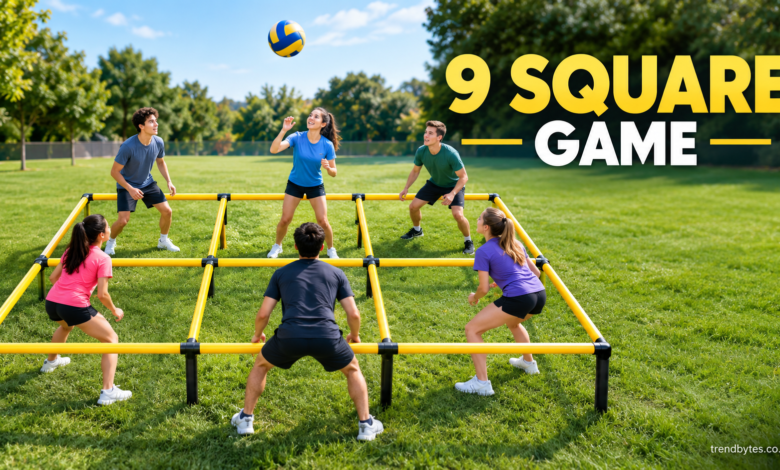
The 9 square game is a fast-paced group activity that combines movement, timing, coordination, and friendly competition. It is often played at camps, schools, youth events, parties, family gatherings, and community activities. The basic concept is simple: players stand in individual sections of a nine-square grid and try to keep the ball moving while protecting their own space.
Unlike many traditional board games, the 9 square game gets people on their feet. Players need to watch the ball, react quickly, and decide where to hit it next. Because the rules are easy to understand, beginners can usually join after watching only a few rounds.
Whether you are planning a party activity or simply want to understand how the game works, this guide covers the setup, rules, strategies, variations, common mistakes, and practical tips for making every round more enjoyable.
What Is the 9 Square Game?
The 9 square game is a recreational grid game played with nine connected sections arranged in a three-by-three formation. Each player occupies one section and attempts to send a lightweight ball into another player’s area.
The center position is usually surrounded by eight outside positions. Players use their hands to hit the ball upward and across the grid.
The main challenge is controlling the ball while reacting to other players. A successful player needs both physical coordination and quick decision-making.
Although the basic structure is easy, the game can become surprisingly competitive when players start using different angles, speeds, and strategies.
How Does the 9 Square Game Work?
The game starts with players positioned inside the nine sections. One player begins by serving or hitting the ball upward.
The ball must travel through the playing area and enter another player’s square. That player then attempts to return it before it hits the ground or violates the agreed rules.
A player can be eliminated or lose a point when they make a mistake. Depending on the version being played, the open position can then be filled by another participant.
This creates a continuous rotation that allows many people to participate during a single session.
9 Square Game Setup
A standard setup requires a nine-square frame, a suitable ball, and enough open space for players to move safely.
The nine sections should be clearly defined so that every participant knows their playing area. The frame needs to be stable and positioned on a flat surface.
Before beginning, check the surrounding area for furniture, sharp objects, slippery surfaces, or other obstacles.
For younger players, use a lightweight ball that is easy to control. A softer ball can also reduce the chance of uncomfortable impacts during fast rounds.
Choosing the Right Playing Area
Indoor and outdoor spaces can both work well.
For outdoor play, a level grassy area or another appropriate surface is ideal. Indoors, make sure there is enough clearance above and around the structure.
Avoid placing the game near glass, fragile decorations, busy walkways, or low ceilings.
Safety should always come before competition.
Basic 9 Square Game Rules
The exact rules can vary depending on the group, but a simple version can be played with these basic principles:
- Each player starts in one square.
- One player begins with the ball.
- The ball is hit upward into another player’s section.
- The receiving player must return it to another section.
- Players continue hitting the ball as it moves around the grid.
- A player loses the round or point after making a defined mistake.
- Players rotate when someone is eliminated or a new participant enters.
Before playing, agree on what counts as an error. This prevents arguments and keeps the game moving.
For example, your group might decide that a player is out if the ball lands inside their square, they hit the ball outside the structure, or they hold or carry the ball instead of striking it.
How to Play the 9 Square Game
Start by placing players in all nine sections. If fewer than nine people are available, you can modify the game or rotate players through empty positions.
Choose the starting player and establish the serving direction.
Once the first hit is made, the receiving player should immediately track the ball and prepare to return it. Players should stay alert because the ball can move quickly between sections.
When someone makes a mistake, stop briefly, identify the next player or rotation, and restart the rally.
For larger groups, keep waiting players organized so they can quickly enter when a position becomes available.
9 Square Game Strategies
Although the game looks simple, strategy can make a major difference.
The first important skill is ball control. Instead of hitting as hard as possible, try to direct the ball accurately.
A controlled hit can be more effective than a powerful one because it gives you greater control over where the ball travels.
Watch the Whole Grid
Do not focus only on the ball when it is directly above you.
Keep an eye on nearby players and anticipate where the next return might go. This helps you prepare before the ball reaches your square.
Experienced players often react before the ball arrives because they recognize the direction and angle of the previous hit.
Use Different Angles
A predictable return makes it easier for another player to respond.
Try changing the angle of your hits while staying within the rules. A higher return may give you more time to prepare, while a controlled side angle can make the next player work harder.
The goal is not simply to hit harder. It is to make smart, accurate decisions.
Stay Balanced
Good footwork matters.
Keep your knees slightly bent and maintain a comfortable stance. Avoid standing completely still because you may need to move quickly when the ball changes direction.
Balance also makes it easier to control your hands and react naturally.
Common Mistakes to Avoid
One of the most common mistakes is trying to hit every ball with maximum force.
Power does not guarantee success. A hard hit can become difficult to control and may send the ball outside the intended area.
Another mistake is watching only your own square. The game develops quickly, so awareness of the surrounding players is important.
Players also sometimes forget to establish rules before starting. If one person thinks catching is allowed while another considers it a violation, disagreements can interrupt the game.
Finally, avoid unsafe movements. Do not climb onto the structure, push another player, or make aggressive contact simply to reach the ball.
Tips for Beginners
If you are playing for the first time, focus on control rather than winning.
Start by learning how the ball moves through the grid. Try to make clean, gentle hits and observe how different angles affect its direction.
It also helps to watch experienced players for a few minutes before joining.
Do not become frustrated if you make several mistakes. The game is designed around quick reactions, and coordination improves naturally with practice.
A beginner-friendly session should prioritize learning and participation rather than intense competition.
How to Make the 9 Square Game More Fun
Once everyone understands the basic rules, you can introduce variations.
For example, create themed rounds where players must follow a specific serving rule. You could also introduce a tournament format where players earn points across multiple rounds.
Another option is to use different types of lightweight balls. Just make sure the ball is appropriate for the players and playing environment.
You can also create team-based challenges if your group is large.
Add a Rotation System
A structured rotation keeps everyone involved.
When a player is eliminated, the next person in line enters the open position. Players can move through the squares according to a predetermined direction.
This prevents confusion and reduces waiting time.
For parties and camps, a rotation system is especially useful because it allows many participants to play without requiring everyone to remain on the court simultaneously.
9 Square Game for Kids and Families
The game can be an excellent activity for family events because it encourages movement while remaining easy to understand.
For younger children, use simple rules and a slower pace. A lightweight ball is usually easier for beginners to control.
Adults can also participate, making the activity more inclusive.
The most important consideration is creating rules that match the age and ability of the group. If the game becomes too fast, slow the pace down and give beginners more opportunities to practice.
9 Square Game for Parties and Events
The game works particularly well at events where people need an activity that encourages interaction.
At a birthday party, for example, you can organize short rounds and rotate participants frequently. At a school or camp, several rounds can be used as part of a larger activity schedule.
For a large gathering, establish a clear waiting line and explain the rules before the first round begins.
A simple scoring system can also add excitement without making the activity complicated.
Safety Best Practices
Safety is an important part of any active group game.
Inspect the frame before playing and make sure it is properly assembled and stable. Check that the playing surface is suitable and free from hazards.
Participants should have enough room to move without colliding with nearby objects.
Avoid playing in dangerous weather conditions or areas where the surface becomes slippery.
Players should also understand that competition should never involve pushing, grabbing, or intentionally interfering with another person.
If someone is tired or uncomfortable, allow them to take a break.
People Also Ask About the 9 Square Game
What is the 9 square game?
The 9 square game is an active group game played on a three-by-three grid. Players stand in individual sections and hit a ball between the squares while trying to avoid making mistakes.
How many players can play the 9 square game?
The standard format has nine playing positions, but the total number of participants can be larger when players rotate in and out of the grid.
What ball is used for the 9 square game?
A lightweight ball is generally suitable. The best choice depends on the players, age group, environment, and specific rules being used.
Is the 9 square game good for kids?
Yes. With age-appropriate equipment and rules, it can encourage movement, coordination, reaction speed, and social interaction.
Can adults play the 9 square game?
Absolutely. Adults can play casually or competitively. Adjusting the pace and rules can make the game suitable for different skill levels.
How do you win the 9 square game?
Winning conditions depend on the rules. In many versions, players stay in the game by avoiding errors and advance through positions when other players make mistakes.
Can you play the 9 square game indoors?
Yes, provided there is enough space, adequate ceiling clearance, and a safe playing surface. The surrounding area should be free of fragile or dangerous objects.
How can I make the game more challenging?
You can increase the pace, introduce scoring systems, create tournament rounds, or add variations that require more precise ball control.
Conclusion
The 9 square game is a simple but highly engaging activity that brings together movement, coordination, strategy, and friendly competition. Its three-by-three structure makes it easy to understand, while the fast-moving ball keeps every player involved.
For beginners, the best approach is to focus on accuracy, balance, and awareness rather than power. As players improve, they can experiment with angles, timing, rotations, and different game variations.
Whether you are organizing a family gathering, school activity, camp, party, or community event, the 9 square game offers an entertaining way to get people moving and interacting. With clear rules, safe equipment, and a fair rotation system, it can provide quick rounds of fun for players of many ages and skill levels.