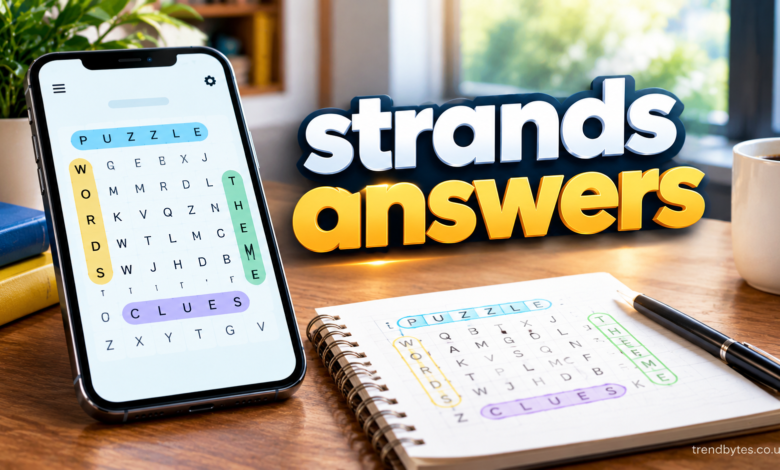
If you enjoy word puzzles, searching for strands answers can help you understand a difficult puzzle, discover useful hints, or check whether you found every hidden word. Strands is a word-search game from The New York Times that challenges players to connect letters, uncover words related to a daily theme, and find a special word called the spangram.
Unlike a traditional word search, Strands requires more than spotting familiar letter combinations. You need to understand the theme, explore the letter grid, and identify words that may run in different directions.
Whether you are a beginner or a regular player, this guide explains how Strands works, how to use hints effectively, and which strategies can make daily puzzles easier. It also covers common mistakes and answers frequently asked questions about the game.
One important note: this is a general guide, not a verified answer sheet for today’s puzzle. The exact answers change daily, so check the puzzle’s date before relying on any answer list.
What Is the Strands Word Game?
Strands is a daily word-search puzzle published by The New York Times Games. Each puzzle presents a grid of letters and a theme that connects the words players must discover.
Your task is to find all the theme-related words and the spangram. The spangram is a special word or phrase that captures the puzzle’s central idea and stretches across the grid, touching two opposite sides.
The game combines vocabulary, pattern recognition, and logical thinking. Some puzzles are easy to understand immediately, while others use indirect themes, expressions, or less familiar words.
How Strands Differs From Other Word Games
Strands shares some features with games such as Wordle and traditional word searches, but its mechanics are different.
- Wordle: Players guess a single five-letter word using feedback from each attempt.
- Traditional word search: Players locate listed words within a letter grid.
- Strands: Players identify a theme, uncover related words, and find a spangram without receiving a complete word list at the start.
This combination makes Strands especially rewarding for players who enjoy solving clues and discovering connections between words.
How to Play Strands
Understanding the basic rules is the first step toward solving the puzzle efficiently.
Step 1: Read the Daily Theme
Every Strands puzzle begins with a theme clue. This clue may describe a category, a familiar phrase, a shared activity, or a more abstract concept.
For example, a theme such as “Things in a Kitchen” might lead you to words like SPOON, OVEN, and KETTLE. These are illustrative examples, not answers to a specific daily puzzle.
Think about several possible interpretations of the clue before searching the grid.
Step 2: Search the Letter Grid
Look for letter combinations that could form words related to the theme. In Strands, you select adjacent letters to build a word, and the path can change direction.
Words can travel horizontally, vertically, or diagonally. You may need to follow a winding path instead of reading straight across a row.
Step 3: Find the Theme Words
Every theme word you discover contributes to completing the puzzle. Once you find a valid word, the game marks it in the grid.
Continue searching for words that fit the theme until you have uncovered the required set.
Step 4: Discover the Spangram
The spangram is the central feature that distinguishes Strands from a regular word search. It describes the puzzle’s overall theme and stretches across the board from one side to the opposite side.
It may be a single word or a phrase, depending on the puzzle. Finding it can help you understand the relationship between the remaining theme words.
Step 5: Complete the Puzzle
You finish when all required theme words and the spangram have been found.
If you are stuck, use the game’s hint system rather than repeatedly searching the same letter combinations. A useful hint can help you make progress without revealing every answer immediately.
Strands Answers: How to Find Today’s Solutions
Searching for Strands answers is common when a puzzle feels unusually difficult. However, the best approach depends on whether you want a small nudge, a stronger clue, or the complete solution.
Start With Hints Before Revealing Answers
If you want to preserve the challenge, try solving the puzzle in stages.
- Read the theme clue carefully.
- Think of words associated with the theme.
- Search the grid for possible starting letters.
- Look for short words or familiar combinations.
- Use an in-game hint if you become stuck.
- Check the complete answers only when necessary.
This method gives you a chance to solve the puzzle yourself while avoiding unnecessary frustration.
Check the Correct Puzzle Date
Daily Strands puzzles change, so an answer list must match the date of the puzzle you are playing.
If you search for “Strands answers today,” make sure the page clearly identifies the correct date and puzzle. An answer list from yesterday may be accurate for that puzzle but completely unhelpful for today’s grid.
Time zones can also affect when you consider a puzzle to be today’s puzzle. Check the date displayed by the game rather than relying only on the publication date of an answer page.
Understand the Difference Between Hints and Full Answers
A hint offers guidance without necessarily giving away a word. For example, a theme hint might suggest a type of food, a sport, or a household activity.
A full answer list reveals the actual theme words and spangram. This is useful when you want to check your completed puzzle or understand a solution you could not find.
Choose the level of help that suits your goal.
Best Strategies for Solving Strands Puzzles
You do not need an unusually large vocabulary to become better at Strands. A consistent solving method can make a noticeable difference.
1. Break the Theme Into Categories
Start by listing several ideas related to the theme.
Suppose a puzzle has a theme involving travel. You might think about transportation, luggage, destinations, and activities. These categories give you more directions to explore than focusing on a single interpretation.
Keep your ideas flexible. The theme may refer to a phrase or a less obvious connection rather than a simple category.
2. Look for Unusual Letters
Letters such as Q, X, Z, and J can be useful starting points because they appear less frequently in common English words.
If you see one of these letters, check whether it could begin or form part of a word that fits the theme.
However, do not assume every unusual letter belongs to a theme word. Some letters may be more useful after you discover surrounding words.
3. Search for Common Letter Patterns
Recognizing common combinations can help you spot words more quickly.
Look for patterns such as TH, CH, SH, ING, and common word endings. These combinations can reveal potential words even when their paths turn diagonally or change direction.
For example, if you notice the letters ING connected to a plausible starting sequence, consider whether the resulting word fits the theme.
4. Use Found Words to Narrow Your Search
Every word you discover provides information about the puzzle’s theme.
If you find several words related to cooking, for example, you can focus on ingredients, kitchen equipment, or cooking methods rather than unrelated topics.
This process of narrowing possibilities helps reduce random guessing.
5. Search the Edges of the Grid
The spangram must connect opposite sides of the board, so the edges can offer useful clues.
Look for promising letter sequences near the top, bottom, left, and right sides. Consider whether a word or phrase could travel through the middle of the grid and reach the opposite edge.
Finding the spangram early may make the rest of the puzzle easier, although it is not always the easiest word to identify first.
How Strands Hints Work
The in-game hint system is particularly helpful when you cannot find another theme word.
In general, Strands lets players earn hints by finding words that are not part of the puzzle’s theme. These words are often called non-theme words.
The exact behavior and interface may change, so follow the instructions displayed in your current game.
Use Non-Theme Words to Earn Hints
When you identify a valid non-theme word, the game can count it toward hint progress. After you meet the required threshold, you can activate a hint that helps reveal a theme word.
This creates an alternative way to make progress when the main theme is difficult to interpret.
Rather than clicking random letters, look for complete words you can recognize confidently.
When Should You Use a Hint?
Use a hint when you have explored several reasonable possibilities and are no longer making progress.
For example, if you have found most of the theme words but cannot identify the final one, a hint may help you recognize a word hidden in an unfamiliar path.
If you enjoy solving puzzles independently, wait until you have exhausted your strongest ideas before requesting assistance.
Common Strands Mistakes to Avoid
Even experienced players can get stuck by repeating the same habits. Avoiding these mistakes can make your solving process more efficient.
Taking the theme too literally: A theme may refer to a broad concept, a word association, or a familiar expression. Consider several interpretations.
Searching only in straight lines: Words can change direction and use diagonal connections. Follow promising paths rather than limiting yourself to rows and columns.
Ignoring short words: A short word may be just as important as a longer one. Do not focus only on words that immediately stand out.
Forgetting the spangram: The spangram is essential to completing the puzzle. Keep it in mind as you identify the other theme words.
Repeating unsuccessful searches: If a path does not produce a recognizable word, move on and revisit it later with a different idea.
Reading answers too early: If your goal is to improve, give yourself time to think before checking a complete answer list. Understanding why a word fits the theme is more useful than memorizing the solution.
Why Strands Is a Good Daily Brain Challenge
Strands offers a short, accessible activity that combines language skills with problem-solving.
Players must interpret a clue, identify related concepts, recognize letter patterns, and navigate a grid. These tasks encourage focused thinking and can make a daily break more engaging.
The game can also help you encounter unfamiliar words or think about familiar words in new ways.
However, it is best viewed as entertainment rather than a guaranteed way to improve memory or prevent cognitive decline. Enjoy the challenge at your own pace, and do not worry if some puzzles take longer than others.
People Also Ask About Strands Answers
1. Where can I find today’s Strands answers?
Look for a daily Strands answer guide that clearly displays the date and puzzle theme. Check that the date matches the puzzle you are playing before using the listed solutions.
2. What is the Strands spangram?
The spangram is a special word or phrase that describes the puzzle’s overall theme. It stretches across the grid, touching two opposite sides, and is required to complete the puzzle.
3. How many words are in a Strands puzzle?
The number of theme words can vary by puzzle. Players must find all the required theme words and the spangram to complete the game.
4. Can I get hints in Strands?
Yes. The game provides a hint system that can help reveal theme words. Players can generally earn hint progress by finding valid non-theme words in the grid.
5. Is Strands harder than Wordle?
It depends on your strengths. Wordle focuses on guessing a five-letter word, while Strands requires players to interpret a theme and find several connected words in a grid. Some players find one format easier than the other.
6. Can Strands words go diagonally?
Yes. Strands words can follow adjacent letters horizontally, vertically, and diagonally. Their paths can also change direction, so they do not need to form straight lines.
7. Does Strands have a new puzzle every day?
Strands is designed as a daily puzzle, with a new challenge each day. If you are checking answers online, confirm the puzzle date to avoid confusing different solutions.
8. What should I do if I cannot solve Strands?
Read the theme again, brainstorm related words, explore different letter paths, and look for the spangram along the grid’s edges. If you remain stuck, use an in-game hint or consult an answer guide for the correct date.
Conclusion
Finding strands answers becomes easier when you understand the game’s theme-based word search, flexible letter paths, and special spangram. Instead of guessing randomly, begin with the clue, explore related word categories, and use each discovered word to narrow your search.
If you are looking for today’s complete solutions, always check the date and make sure the answer list matches your current puzzle. When you need a little help, start with hints before revealing every word.
With regular practice, you can develop a more organized approach to Strands, recognize useful letter patterns, and enjoy the daily challenge with less frustration. Whether you solve every word independently or occasionally use a hint, the goal is to make each puzzle an enjoyable part of your day.