Brass Monkey One Trip Nick Wooden Balance Game: Complete Guide

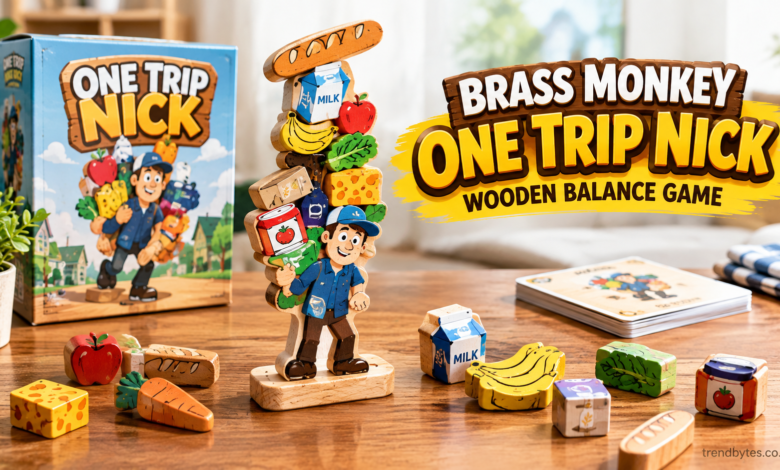
The brass monkey one trip nick wooden balance game turns a familiar everyday challenge into a funny tabletop competition: trying to carry an unreasonable amount of groceries in one trip. Instead of making multiple trips from the car, players help the wobbly character Nick hold increasingly ridiculous items without causing the entire stack to tumble.
Designed as a wooden stacking and balancing game, One Trip Nick combines simple rules with dexterity and plenty of laughs. Players take turns adding grocery-themed pieces to Nick while trying not to be the person who makes everything fall.
The game is easy to understand, making it suitable for casual game nights, family gatherings, parties, and quick entertainment. This guide explains how it works, what comes in the box, how to play, useful strategies, common mistakes, and who is likely to enjoy it most.
What Is the Brass Monkey One Trip Nick Wooden Balance Game?
The Brass Monkey One Trip Nick Wooden Balance Game is a tabletop dexterity game built around one simple idea: stack as many items as possible without knocking Nick over.
The game uses a man-shaped starting piece and wooden grocery-themed pieces. Players take turns placing the pieces on Nick, gradually creating a precarious pile.
The challenge comes from balance. Each new piece changes the weight and position of the stack, so a move that looks safe can suddenly make the entire arrangement unstable.
Brass Monkey describes it as a humorous balance game based on the idea of refusing to make two trips when carrying groceries. The product includes 19 wooden game pieces with double-sided printing and an instruction sheet.
How Does One Trip Nick Work?
The basic gameplay is straightforward.
Players take turns adding the wooden pieces to Nick. The objective is to place pieces carefully enough that the structure remains standing.
The tension increases as more objects are added. Early moves may seem easy, but later pieces require much more attention because the available stable positions become limited.
Eventually, someone places a piece that causes Nick or the stack to fall. That player loses the round under the standard concept of the game.
Because the rules are simple, most of the fun comes from watching the structure become increasingly unstable.
What Makes the Balance Challenge Fun?
The game combines skill and unpredictability.
You can make a careful placement, but the existing stack may already be close to its tipping point. This means even a seemingly reasonable move can produce an unexpected result.
That uncertainty creates the main source of excitement. Players are constantly asking themselves whether they should make a safe placement or attempt a more ambitious one.
What’s Included With One Trip Nick?
The game comes with wooden components designed around the grocery-carrying theme. The pieces feature double-sided printed designs, giving the set a playful vintage-inspired appearance.
The official product information lists 19 wooden game pieces along with an instruction sheet.
The compact format also makes the game convenient to store and bring to a gathering. One retailer lists the package at approximately 4 by 7 by 1.85 inches, showing how small the complete game can be compared with larger tabletop games.
How to Play the Brass Monkey One Trip Nick Wooden Balance Game
Before starting, place Nick on a stable, flat playing surface.
Separate the wooden pieces so everyone can easily reach them. Players then decide who goes first.
On each turn, a player selects an available piece and carefully places it on Nick or the existing stack, following the instructions included with the game.
The key objective is to avoid being the player who causes the balance to fail.
Keep turns moving at a reasonable pace. Part of the entertainment comes from seeing players hesitate as they try to decide where a difficult piece should go.
Best Strategies for One Trip Nick
Although One Trip Nick is designed primarily as a fun dexterity game, players can still develop useful strategies.
The most important principle is stability over speed.
Do not automatically choose the largest or easiest-looking position. Examine how the entire stack is balanced before placing your piece.
Keep the Weight Centered
When possible, try to keep the combined weight of the pieces close to the center of the supporting area.
A piece placed too far to one side can shift the center of gravity and make later moves much harder.
This becomes increasingly important as the stack grows.
Look Before You Place
Do not pick up a piece and immediately put it down.
First, examine the current structure. Look for areas that appear more stable and consider how the new piece will affect the existing balance.
A few seconds of observation can make a major difference.
Think About the Next Player
The best move is not always the one that makes your own turn easy.
Consider what the next player will have to do. If you leave the structure in a particularly unstable position, the next person may be forced into a difficult placement.
This adds a light strategic element to what initially looks like a simple stacking game.
Common Mistakes to Avoid
The biggest mistake is rushing.
Players sometimes become so focused on finishing their turn that they fail to consider how a piece will affect the rest of the stack.
Another mistake is placing objects too far from the center without considering the weight distribution.
It is also easy to touch or adjust several pieces unnecessarily. Unless the rules allow it, keep your turn focused on the piece you are actually placing.
Finally, avoid turning the game into a physical contest. The fun comes from precision, balance, and laughter, not from aggressively manipulating the pieces.
Is One Trip Nick Good for Families?
The game is designed to be easy to understand, which makes it a natural choice for casual family entertainment.
The listed recommended age is 5 and up, although younger children should always be supervised according to the condition of the pieces and the playing environment.
Children can practice hand-eye coordination and careful movement while adults can enjoy the competitive side of the game.
Because the rules do not require complicated reading or advanced strategy, new players can usually join without a long explanation.
One Trip Nick for Parties and Game Nights
One Trip Nick can work particularly well when a group wants something quick and social.
Unlike a long strategy game, the basic concept can be explained quickly. Players can take turns, laugh at unexpected collapses, and start another round without a lengthy reset.
The game’s party appeal comes from its visual humor as much as its mechanics. Watching a ridiculous collection of objects balance on Nick creates a natural conversation starter.
It can also work as a short activity between longer games.
Why Wooden Balance Games Are So Appealing
Wooden dexterity games have a different appeal from digital games.
Players physically handle the components, watch the structure change, and experience the result of every move directly.
That hands-on experience can make a simple mechanic feel surprisingly engaging.
One Trip Nick also benefits from its unusual theme. Rather than using generic blocks, it turns the familiar grocery-carrying situation into the central joke of the game.
Expert Tips for Better Gameplay
If you want to make your rounds more competitive, establish the rules clearly before the first turn.
Everyone should understand what happens when Nick falls and whether players can reposition pieces after touching them.
For beginners, let players take their time during the first few rounds. Once everyone understands the balance mechanics, encourage faster turns.
You can also keep track of successful rounds to create a simple tournament. For example, players could receive a point whenever they survive a complete turn, with the highest total winning after several rounds.
This adds structure without making the game unnecessarily complicated.
How to Make One Trip Nick More Challenging
Once players become comfortable with the basic gameplay, you can introduce optional house rules.
One idea is to impose a short decision timer. Players must choose and place their piece within a set amount of time.
Another option is to prevent players from testing a piece against the stack before committing to their move.
You could also create a multi-round competition where players earn points based on how long they remain in the game.
Keep optional rules simple, however. The strength of One Trip Nick is its accessible core mechanic.
One Trip Nick vs. Traditional Stacking Games
Traditional stacking games often involve uniform blocks or pieces with predictable shapes.
One Trip Nick takes a different approach by using irregular, themed wooden pieces. This creates more visual variety and makes each placement feel less predictable.
The grocery theme also gives the game a clear personality.
Instead of simply asking players to build a tower, the game creates a humorous story around Nick’s determination to carry everything in one trip.
Is One Trip Nick Worth Considering?
For people who enjoy short, social dexterity games, One Trip Nick has a straightforward appeal.
It does not require players to memorize complicated rules or spend a long time learning a strategic system. Instead, it focuses on physical balance, quick decisions, and the comedy of watching an unstable stack develop.
The game was released in 2025 and is listed as a 2–4 player game on BoardGameGeek, with a recommended age of 5+.
That makes it particularly suited to small groups looking for a light activity rather than a long competitive session.
People Also Ask About the Brass Monkey One Trip Nick Game
What is the Brass Monkey One Trip Nick wooden balance game?
It is a wooden dexterity game in which players take turns stacking grocery-themed pieces onto a man-shaped character named Nick while trying not to knock the arrangement over.
How many pieces are included in One Trip Nick?
The game includes 19 wooden game pieces with double-sided printing, along with an instruction sheet.
What age is One Trip Nick suitable for?
The product is recommended for ages 5 and up. Parents and caregivers should still consider the child’s ability to handle the pieces safely.
How many people can play One Trip Nick?
BoardGameGeek lists the game for 2–4 players.
What is the goal of One Trip Nick?
The goal is to add the grocery-themed pieces while keeping Nick and the growing arrangement balanced. Players want to avoid being the person whose move causes everything to fall.
Is One Trip Nick a strategy game?
It is primarily a dexterity and stacking game, but players can use strategy by considering weight distribution, placement, stability, and the difficulty their move leaves for the next player.
Is One Trip Nick good for family game nights?
Yes. Its simple concept, physical components, and short learning curve make it well suited to casual family gatherings and game nights.
How can you get better at One Trip Nick?
Focus on balance rather than speed. Study the existing stack before making a move, keep weight centered when possible, and think about how your placement will affect the next turn.
Conclusion
The Brass Monkey One Trip Nick Wooden Balance Game takes a familiar everyday habit and turns it into a clever tabletop dexterity challenge. Its wooden pieces, humorous grocery theme, and increasingly unstable stack create a game that is easy to learn but entertaining to watch and play.
The best approach is to slow down, study the balance, and place each piece with care. Once players understand the basics, optional timers, scoring systems, and tournament-style rounds can add more competition.
If you enjoy hands-on games that combine simple rules, physical skill, humor, and unpredictable moments, One Trip Nick is an interesting choice for family gatherings, parties, and casual game nights.