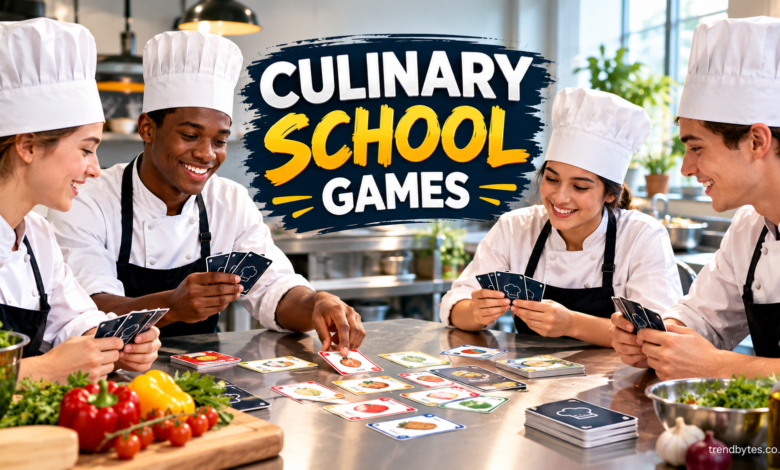
Culinary school games can turn cooking education into something more interactive, memorable, and enjoyable. Whether you are a culinary student, instructor, home cook, or someone interested in cooking simulations, games can help develop skills such as recipe planning, ingredient recognition, kitchen safety, timing, and food preparation.
Not every culinary game needs to involve a computer. Some are digital cooking simulations, while others are hands-on classroom challenges that can be played with ingredients, recipe cards, timers, or kitchen equipment.
The best activities combine fun with useful skills. Instead of simply testing who can cook fastest, a good culinary game encourages players to think like chefs and make smart decisions under realistic kitchen conditions.
What Are Culinary School Games?
Culinary school games are interactive activities designed around cooking, food preparation, kitchen management, or culinary knowledge.
They can range from cooking simulation games to classroom competitions. Some focus on basic skills, while others challenge players to manage an entire restaurant or create dishes from limited ingredients.
Common examples include:
- Recipe challenges
- Ingredient identification games
- Cooking simulations
- Knife-skill challenges
- Mystery ingredient competitions
- Food safety quizzes
- Menu-planning games
- Restaurant management simulations
- Baking challenges
- Timed cooking activities
The main goal is to make learning active. Students have to observe, decide, solve problems, and apply knowledge instead of simply memorizing information.
Why Culinary School Games Are Useful for Learning
Cooking involves many skills at once. A student may need to understand ingredients, follow a recipe, manage heat, control timing, maintain hygiene, and present the finished dish.
Games can isolate these skills and let students practice them in a less intimidating environment.
For example, a recipe sequencing game can teach students how preparation steps relate to one another. A food-safety challenge can help them recognize unsafe kitchen practices.
Games also encourage repetition. A student who repeatedly practices identifying ingredients or organizing a kitchen workflow can become faster and more confident over time.
Culinary School Games Build Real Kitchen Skills
The strongest culinary games connect directly to practical skills.
A student might learn:
- Mise en place organization
- Ingredient measurement
- Recipe interpretation
- Cooking terminology
- Food safety
- Time management
- Flavor pairing
- Menu development
- Kitchen communication
- Basic cost awareness
This makes games especially useful as supplemental learning activities rather than replacements for hands-on culinary training.
Best Types of Culinary School Games
Different games work better for different learning goals. Choosing the right activity depends on the students’ age, experience, and culinary level.
1. Ingredient Identification Games
Place several ingredients on a table and challenge players to identify them.
For beginners, use familiar ingredients such as carrots, onions, garlic, basil, cinnamon, or common fruits.
For advanced students, introduce less familiar ingredients, spices, herbs, or specialty products.
You can increase the difficulty by asking players to identify ingredients using smell, texture, or appearance.
This activity helps develop sensory awareness, which is an important part of cooking.
2. Recipe Challenge Games
Give students a recipe and ask them to identify the correct order of preparation steps.
For example, the cards might include:
- Prepare the vegetables.
- Heat the pan.
- Add the cooking fat.
- Sauté the vegetables.
- Add the remaining ingredients.
- Finish and serve.
Mix the cards and let students put them back into the correct sequence.
This simple game teaches organization and helps students understand why cooking steps happen in a particular order.
3. Mystery Basket Challenges
The mystery basket is one of the most exciting culinary activities.
Give players a selection of ingredients and ask them to create a dish using a required number of them.
The challenge can be adapted to almost any skill level.
Beginners might receive five familiar ingredients. Advanced students could receive unusual combinations and a limited preparation time.
The focus should not only be on speed. Judges can score creativity, technique, flavor balance, presentation, and efficient ingredient use.
4. Culinary Trivia Games
Culinary trivia is useful when students need to review theory.
Questions can cover:
- Cooking methods
- Kitchen terminology
- Food safety
- Herbs and spices
- International cuisines
- Baking principles
- Equipment
- Ingredient substitutions
Turn the questions into teams or a quiz-show format to make review sessions more engaging.
Cooking Simulation Games
Digital cooking simulations offer another way to explore culinary concepts.
In a cooking simulation, players may prepare virtual dishes, follow recipes, manage cooking times, serve customers, or operate a restaurant.
These games can be useful because they allow players to experiment without wasting real ingredients.
However, digital simulations should be viewed as practice or entertainment rather than a substitute for real kitchen experience.
A virtual frying pan cannot teach exactly how food smells, sounds, feels, or changes during actual cooking.
Restaurant Management Games
Culinary education is not limited to preparing food.
Many aspiring chefs eventually work in environments where inventory, customer service, staffing, pricing, and scheduling matter.
Restaurant management games can introduce these concepts in an accessible way.
Players may need to decide:
- What ingredients to purchase
- Which dishes belong on the menu
- How to price meals
- How to handle busy periods
- How to manage inventory
- How to respond to customers
- When to upgrade equipment
These decisions introduce students to the business side of the food industry.
Culinary School Games for Beginners
Beginners benefit from activities with simple rules and clear objectives.
Good starting options include ingredient matching, recipe sequencing, kitchen vocabulary quizzes, and basic food-safety games.
Avoid making the first activity too difficult. If students are still learning basic culinary terms, a complicated timed competition may create unnecessary pressure.
Instead, start with knowledge-based activities and gradually introduce practical challenges.
As confidence improves, students can move toward more complex cooking competitions and mystery ingredient challenges.
Culinary School Games for Advanced Students
Experienced students can handle activities that require multiple decisions at once.
Try creating a simulated restaurant service where teams must prepare several dishes within a specific time.
Another option is a menu-development challenge. Give students a target customer, budget, cuisine style, and ingredient list.
They then create a small menu and explain their choices.
Advanced students can also compete on food cost, presentation, flavor combinations, and efficiency.
Try a Chef Decision-Making Challenge
Give students a fictional kitchen problem.
For example:
A restaurant has received a large group reservation, but one major ingredient is unavailable.
Students must decide how to modify the menu without sacrificing quality.
This type of game teaches adaptability, communication, and problem-solving.
Those skills are valuable in real professional kitchens because unexpected problems are part of food service.
Fun Culinary Classroom Activities
A culinary classroom does not have to rely entirely on competitive games.
Collaborative activities can be just as effective.
Try dividing students into teams and assigning each group a different cuisine. Each team can research common ingredients, cooking methods, traditional dishes, and presentation styles.
Another activity is a menu-pairing game.
Give students several main dishes and ask them to choose appropriate sides, sauces, beverages, or desserts. They must explain why each combination works.
This encourages students to think about flavor, texture, balance, and customer expectations.
Common Mistakes When Using Culinary Games
One mistake is focusing too heavily on speed.
Fast cooking is not automatically good cooking. A student who rushes may make mistakes, waste ingredients, or ignore safety procedures.
Another mistake is making the rules unnecessarily complicated.
Students should understand the objective quickly. If they spend more time learning the game than applying culinary concepts, the activity needs to be simplified.
It is also important not to reward unsafe behavior.
Never create a competition that encourages students to handle knives carelessly, ignore hygiene, rush around a kitchen, or skip important safety procedures.
Best Practices for Culinary Game Activities
For better results, connect every game to a clear learning objective.
Before starting, ask yourself what students should learn from the activity.
For example:
- Ingredient game → sensory recognition
- Recipe game → sequencing
- Trivia game → theory review
- Mystery basket → creativity
- Restaurant simulation → business decisions
- Timed challenge → workflow and organization
Keep scoring transparent. Students should know how performance is measured.
It is also helpful to include a short discussion after the game. Ask students what worked, what went wrong, and what they would change next time.
That reflection can turn a fun activity into a meaningful learning experience.
How to Create Your Own Culinary School Game
You do not need expensive equipment to create a useful culinary game.
Start with a simple objective.
Suppose you want to teach food safety. Create cards showing different kitchen situations. Players must decide whether each situation is safe or unsafe and explain why.
For recipe knowledge, create ingredient and instruction cards. Students match the correct ingredients to a recipe and arrange the preparation steps.
For restaurant management, create a fictional budget and menu. Players make purchasing decisions while trying to maintain profitability.
The best homemade games are simple, repeatable, and connected to skills students actually need.
How to Make Culinary Games More Competitive
Competition can make a classroom activity more exciting when used carefully.
You can award points for:
- Correct answers
- Efficient preparation
- Creativity
- Organization
- Presentation
- Accurate measurements
- Good teamwork
Avoid awarding points solely for being the fastest.
A balanced scoring system encourages students to value quality as well as efficiency.
You can also create levels. Beginners start with basic challenges, while advanced players unlock more difficult scenarios.
Are Culinary School Games Good for Learning?
Yes, when they are designed around meaningful learning objectives.
Games can improve engagement and provide opportunities to practice concepts repeatedly. They can also make difficult topics easier to remember.
However, culinary education requires real-world practice. Students still need hands-on experience with ingredients, equipment, cooking techniques, sanitation, and professional kitchen workflows.
The most effective approach is to combine games with demonstrations, practical exercises, feedback, and reflection.
People Also Ask About Culinary School Games
What are culinary school games?
Culinary school games are cooking-related activities or simulations that teach skills such as recipe knowledge, food safety, ingredient recognition, kitchen organization, and restaurant management.
What is a good culinary game for beginners?
Ingredient identification, recipe sequencing, culinary trivia, and basic food-safety games are excellent starting points because they are easy to understand and do not require advanced cooking skills.
Can culinary games be played in a classroom?
Yes. Culinary games can be adapted for classrooms using recipe cards, ingredient cards, quizzes, team challenges, and simulated restaurant scenarios.
Are cooking simulation games useful for culinary students?
Cooking simulations can help students practice decision-making and understand basic concepts, but they should supplement rather than replace hands-on kitchen training.
What is a mystery basket culinary challenge?
A mystery basket challenge gives players a selection of ingredients and asks them to create a dish using some or all of them. It encourages creativity and problem-solving.
How can culinary games teach food safety?
Games can present realistic kitchen situations and ask students to identify unsafe practices, choose the correct response, or explain proper sanitation procedures.
What skills can culinary games teach?
Depending on the activity, students can practice ingredient recognition, recipe reading, food safety, time management, creativity, teamwork, menu planning, and restaurant decision-making.
Can you create culinary school games at home?
Yes. Simple activities such as recipe sequencing, ingredient matching, culinary trivia, and menu-planning challenges can be created with paper cards and common household materials.
Conclusion
Culinary school games offer a practical way to make cooking education more interactive without losing sight of real culinary skills. From ingredient identification and recipe challenges to mystery baskets and restaurant simulations, there are activities for nearly every learning level.
The most effective games have a clear purpose. They help students practice something useful, whether that is recognizing ingredients, organizing a recipe, making business decisions, or solving an unexpected kitchen problem.
For beginners, start simple. For advanced students, introduce realistic scenarios and more complex decisions. Most importantly, keep safety and quality ahead of speed.
When games are combined with hands-on practice and thoughtful feedback, they can make culinary education more engaging, memorable, and useful both inside and outside the kitchen.