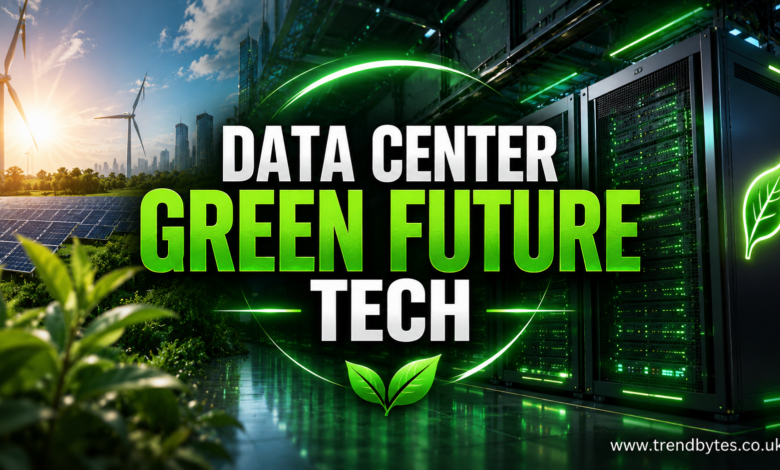
The rapid growth of cloud computing, streaming, connected devices, and advanced computing is changing how much infrastructure the digital world needs. That makes data center green future tech more important than ever. Modern data centers require large amounts of electricity, cooling, water, equipment, and physical space, so improving their environmental performance has become a major technology goal.
Green data center technology is not simply about adding solar panels to a building. It involves a broader strategy that combines energy efficiency, renewable power, smarter cooling, efficient hardware, water management, heat recovery, and intelligent software.
The goal is straightforward: deliver more computing power while using fewer resources and producing less environmental impact.
What Is Data Center Green Future Tech?
Data center green future tech refers to technologies and strategies designed to make data centers more energy-efficient, resource-efficient, and environmentally sustainable.
A traditional data center can consume substantial electricity because its servers operate continuously. However, the servers themselves are only part of the energy equation. Cooling systems, power distribution, networking equipment, lighting, backup systems, and other infrastructure also contribute to overall consumption.
Green technology addresses these areas together.
A sustainable data center may use renewable electricity, highly efficient processors, liquid cooling, advanced power management, energy monitoring, recycled materials, and systems that reuse waste heat.
In simple terms, the future is not just about building bigger data centers. It is about building smarter and more efficient data centers.
Why Green Data Centers Matter
Digital services are becoming essential to everyday life. Businesses use cloud platforms for applications and storage, hospitals depend on digital systems, financial institutions process enormous volumes of transactions, and consumers use online services throughout the day.
As computing demand increases, data center infrastructure must grow.
Without efficiency improvements, higher computing demand can translate into higher energy consumption and greater pressure on local power and water resources.
Green data centers offer a way to separate digital growth from unnecessary resource consumption.
The benefits include:
- Lower electricity consumption
- Reduced operating costs
- Better energy efficiency
- Lower carbon emissions
- Reduced water use
- Improved equipment efficiency
- Greater energy resilience
- Better long-term infrastructure planning
Sustainability can therefore become both an environmental strategy and a business strategy.
How Data Center Green Future Tech Is Changing Infrastructure
The modern green data center is evolving across several technology areas.
Instead of relying on one solution, operators increasingly combine multiple improvements to achieve better overall performance.
1. Renewable Energy Integration
Renewable energy is one of the most visible parts of sustainable data center development.
Solar, wind, hydroelectric power, and other low-carbon energy sources can reduce dependence on electricity generated from fossil fuels.
However, renewable energy is not always available at exactly the moment a data center needs electricity. This creates a need for better energy management.
Battery storage, grid interaction, flexible computing workloads, and improved forecasting can help operators manage variable renewable generation.
For example, a data center connected to a solar-heavy electricity supply could use energy-intensive workloads more strategically during periods when renewable electricity is abundant.
Energy-Efficient Servers and Processors
Servers are at the heart of every data center, so hardware efficiency has a major impact on overall energy use.
Modern processors can deliver significantly more computing performance per watt than older generations. This means operators can sometimes complete the same workload with fewer servers or less electricity.
Energy-efficient CPUs, accelerators, memory systems, storage devices, and networking hardware all contribute to a more sustainable facility.
The key measurement is not simply how much electricity a server uses. Operators should consider how much useful computing work is delivered for each unit of energy.
This concept is especially important as high-performance computing workloads become more demanding.
Advanced Cooling Technology
Cooling is one of the biggest opportunities for improving data center efficiency.
Traditional air cooling uses fans, chillers, pumps, and other equipment to move heat away from servers. As computing density rises, conventional air cooling can become increasingly challenging.
That’s where newer approaches come in.
Liquid Cooling and Data Center Green Future Tech
Liquid cooling is becoming an important part of data center green future tech, particularly for high-density computing.
Liquid can transfer heat more efficiently than air because of its superior thermal properties. Depending on the design, liquid cooling can reduce the amount of energy required for mechanical cooling.
There are several approaches, including direct-to-chip cooling and immersion cooling.
Direct-to-chip systems circulate liquid near major heat-producing components. Immersion cooling places compatible computing equipment in a specialized non-conductive liquid.
These technologies can allow data centers to support higher computing densities while managing heat more efficiently.
Smart Cooling and Artificial Intelligence
Cooling systems do not always need to operate at maximum capacity.
Modern monitoring systems can collect information about temperature, humidity, workload, airflow, and equipment performance. Software can then use this information to adjust cooling operations.
For example, if one area of a facility has a lower computing load, cooling resources can potentially be reduced there while maintaining safe operating conditions elsewhere.
Automated optimization can help eliminate unnecessary energy use.
The important principle is simple: cool according to actual demand rather than a fixed assumption about demand.
Water Efficiency in Data Centers
Energy is not the only environmental concern.
Some cooling systems can consume significant amounts of water, particularly in locations where evaporative cooling is used.
As data center construction expands into regions facing water stress, operators need to consider local water availability when selecting cooling systems and sites.
Potential strategies include:
- Closed-loop cooling
- Direct-to-chip liquid cooling
- Air-cooled systems
- Recycled or reclaimed water
- Improved cooling controls
- Reduced evaporation
- Water-use monitoring
A sustainable data center should evaluate both electricity and water consumption rather than optimizing one while ignoring the other.
Waste Heat Recovery
Servers generate heat, but that heat does not necessarily have to be wasted.
Waste heat recovery systems can capture heat from data center equipment and potentially use it for nearby buildings, district heating systems, greenhouses, or other applications.
This approach works best when a suitable heat user is located nearby.
For instance, a data center built near a residential or commercial heating network may have an opportunity to transfer usable heat instead of simply releasing it into the atmosphere.
This creates an interesting shift in thinking: the data center can become part of a broader local energy system rather than operating as an isolated building.
Better Data Center Design
Sustainability begins before servers are installed.
Facility design influences cooling requirements, airflow, power distribution, maintenance, and future expansion.
Modern facilities can be designed around principles such as:
- Efficient airflow management
- High-density computing zones
- Modular infrastructure
- Efficient electrical systems
- Optimized equipment placement
- Reduced transmission losses
- Renewable energy integration
- Future cooling upgrades
A well-designed facility can remain efficient as computing requirements change.
This is particularly important because replacing or rebuilding major infrastructure can be expensive.
Software Can Make Data Centers Greener
Hardware receives much of the attention, but software also has a role.
Workload scheduling can help organizations use computing resources more efficiently. Virtualization can allow multiple workloads to share physical servers, reducing the need for underused hardware.
Cloud platforms can also consolidate workloads across large infrastructure environments.
Another strategy is workload shifting.
Some computing tasks do not need to happen immediately. If a workload can be completed within a broader time window, software may schedule it when electricity is cheaper, cleaner, or more readily available.
This can make energy management more flexible.
Carbon-Aware Computing
Carbon-aware computing takes the idea of energy optimization one step further.
Instead of looking only at how much electricity a workload uses, systems can consider the carbon intensity of the electricity supplying the data center.
For example, the same amount of electricity may have different environmental impacts depending on whether the local grid is being supplied primarily by renewable or fossil-fuel generation.
Organizations can potentially schedule flexible workloads around cleaner energy periods.
This strategy is particularly useful for batch processing, data analysis, backups, rendering, and other tasks that do not require immediate completion.
Green Data Centers and Edge Computing
Edge computing brings processing resources closer to users and connected devices.
This can reduce the distance data must travel, potentially improving latency and reducing certain network requirements.
However, edge computing also creates a new sustainability challenge because processing equipment can become distributed across many locations.
Instead of one large facility, organizations may operate hundreds or thousands of smaller computing sites.
The future of green edge computing will therefore depend on efficient hardware, remote management, renewable energy, low-power systems, and intelligent workload distribution.
How Companies Can Measure Sustainability
Calling a facility “green” is not enough.
Organizations need measurable performance indicators.
Important metrics can include:
Power Usage Effectiveness (PUE): Measures how efficiently a data center uses energy relative to the energy consumed by IT equipment.
Water Usage Effectiveness (WUE): Helps evaluate water consumption associated with data center operations.
Carbon Usage Effectiveness (CUE): Provides insight into carbon emissions associated with data center energy use.
These measurements allow operators to identify inefficiencies and track improvements over time.
The best sustainability programs measure performance consistently rather than relying on marketing claims.
Practical Example of a Green Data Center
Imagine a new facility designed for high-performance computing.
Instead of installing a conventional cooling system, the operator uses direct-to-chip liquid cooling for high-density servers. The facility purchases renewable electricity, uses efficient processors, monitors power consumption in real time, and employs software that shifts flexible workloads toward periods of lower-carbon electricity.
The building also uses efficient power distribution and captures some waste heat for a nearby application.
No single technology creates the sustainability improvement.
The result comes from combining several systems and managing them as one integrated infrastructure strategy.
Common Mistakes to Avoid
Green data center projects can fail to deliver their expected benefits when organizations focus too narrowly.
Focusing Only on Renewable Energy
Buying renewable electricity is valuable, but inefficient equipment can still waste significant energy.
Energy efficiency should come first, followed by thoughtful renewable energy integration.
Ignoring Water Consumption
A cooling system may reduce electricity use while increasing water demand.
Sustainability decisions should evaluate both resources.
Choosing Technology Without Considering Location
A cooling technology that works well in one climate may not provide the same benefits elsewhere.
Local temperature, humidity, water availability, electricity sources, and grid conditions matter.
Measuring Only Building Efficiency
PUE is useful, but it does not tell the entire sustainability story.
Organizations should also consider carbon emissions, water use, hardware efficiency, and the useful computing output delivered.
Best Practices for a Sustainable Data Center
A strong green data center strategy should include several principles.
First, measure the existing infrastructure before making major changes.
Second, identify the largest sources of energy and resource consumption.
Third, prioritize improvements that provide measurable benefits.
Fourth, design infrastructure for future computing requirements rather than today’s needs alone.
Finally, track performance continuously.
Sustainability should be treated as an ongoing operational process, not a one-time construction project.
The Future of Green Data Center Technology
The next generation of data centers will likely become more intelligent, efficient, and tightly connected to energy systems.
Advanced cooling will support increasingly dense computing environments. Renewable power and battery storage can improve energy flexibility. Smart controls can optimize cooling and electricity use in real time.
Meanwhile, better processors will deliver more computing performance from each watt.
Another important trend will be closer cooperation between data centers and local infrastructure. Facilities may interact with electrical grids, renewable energy projects, heating networks, and water systems in ways that were less common in traditional data center design.
The future is therefore not simply about making individual servers more efficient.
It is about creating a complete digital infrastructure ecosystem that uses energy, water, land, and equipment more intelligently.
People Also Ask About Data Center Green Future Tech
What is data center green future tech?
Data center green future tech refers to technologies and strategies that make data centers more sustainable through energy efficiency, renewable power, advanced cooling, water conservation, efficient hardware, and smarter operations.
Why are green data centers important?
Green data centers can reduce energy consumption, operating costs, carbon emissions, and resource use while helping organizations support growing digital workloads more sustainably.
How does liquid cooling make data centers greener?
Liquid cooling can transfer heat more efficiently than traditional air cooling. In suitable facilities, this can reduce cooling energy requirements and support higher computing density.
Do data centers use a lot of water?
Some data centers use substantial amounts of water for cooling. Water consumption depends on the cooling design, climate, facility size, and operating conditions.
Can renewable energy power data centers?
Yes. Data centers can use renewable electricity through on-site generation, power purchase agreements, renewable energy contracts, or electricity grids with significant renewable generation.
What is PUE in a data center?
Power Usage Effectiveness, or PUE, measures the total energy used by a data center compared with the energy consumed by its IT equipment. A lower PUE generally indicates better facility energy efficiency.
Can software reduce data center energy consumption?
Yes. Virtualization, workload optimization, intelligent scheduling, and carbon-aware computing can help organizations use computing resources more efficiently.
What will future green data centers look like?
Future green data centers are likely to combine efficient processors, advanced liquid cooling, renewable electricity, energy storage, smart controls, water-efficient systems, and automated workload management.
Conclusion
Data center green future tech is becoming a core part of the digital infrastructure industry. As computing demand continues to grow, simply adding more servers is not enough. Data centers need to deliver greater performance while using energy, water, and physical resources more efficiently.
The strongest approach combines multiple technologies: renewable energy, efficient processors, liquid cooling, smart facility controls, water conservation, waste heat recovery, and software-based workload optimization.
For organizations planning new infrastructure, sustainability should be considered from the earliest design stage. For existing facilities, continuous measurement can reveal where efficiency improvements will have the greatest impact.
The future of computing will depend not only on how much technology we can build, but on how intelligently we can power and operate it. That is why data center green future tech will play such an important role in creating a cleaner, more efficient, and more resilient digital future.