Games Booklet: Fun Activities, Puzzles, and Games for All Ages

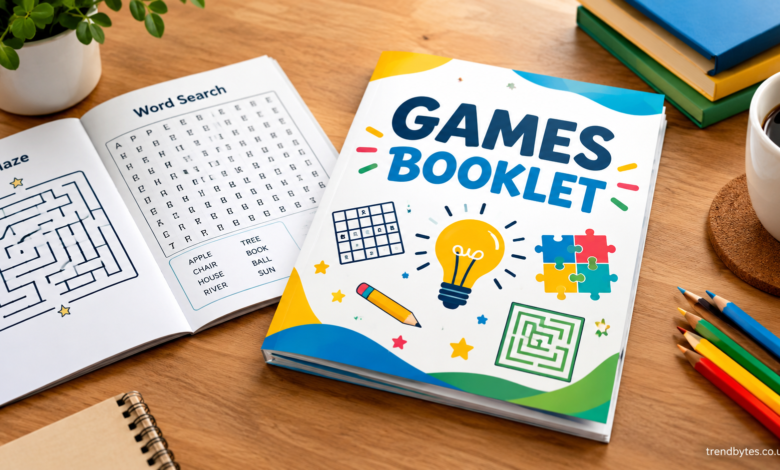
A games booklet is a simple yet entertaining collection of games, puzzles, quizzes, and activities designed to keep people engaged. Whether you’re planning a family gathering, preparing classroom materials, organizing a birthday party, or looking for screen-free entertainment, a well-designed booklet offers plenty of ways to have fun.
Unlike digital games that require a phone, tablet, or computer, a printed games booklet can be used almost anywhere. You can take it on road trips, bring it to school, share it with friends, or enjoy it during a quiet afternoon at home.
The best part is that a games booklet can be customized for different ages, interests, and occasions. From word searches and brain teasers to trivia challenges and drawing activities, there are countless ways to create a collection that people will want to use again and again.
What Is a Games Booklet?
A games booklet is a small printed or digital publication containing multiple activities in one convenient format. It may feature educational exercises, recreational games, logic puzzles, creative challenges, or group activities.
Some booklets focus on a single theme, such as animals, sports, holidays, or mathematics. Others include a variety of games to appeal to different interests.
For example, a children’s booklet might include coloring pages, mazes, matching games, and simple word puzzles. A booklet designed for adults could feature crossword puzzles, trivia questions, Sudoku, and challenging brain teasers.
Games booklets are commonly used in schools, homes, community events, travel activities, restaurants, and entertainment settings.
What Makes a Good Games Booklet?
A successful games booklet combines entertainment, accessibility, and variety. Readers should understand the instructions quickly and feel encouraged to complete each activity.
Important features include:
- Clear instructions: Every game should explain what players need to do.
- Age-appropriate difficulty: Activities should match the intended audience.
- Variety: Include different types of games to maintain interest.
- Readable design: Use legible fonts, adequate spacing, and organized layouts.
- Practical length: Include enough activities to provide value without overwhelming readers.
- Answer keys: Add solutions for quizzes, word puzzles, and other activities when appropriate.
A booklet does not need complicated graphics or expensive printing to be enjoyable. Good content and thoughtful organization are often more important than elaborate design.
Benefits of Using a Games Booklet
A games booklet provides more than entertainment. Depending on the activities included, it can support learning, creativity, social interaction, and mental engagement.
1. Encourages Learning Through Play
Educational games make learning feel less like a formal lesson. Children can practice spelling, counting, reading comprehension, and basic mathematics while completing enjoyable challenges.
For example, a number puzzle can help a child recognize patterns, while a word search introduces new vocabulary. Teachers can also use short activities as warm-ups before beginning a lesson.
The key is to choose games that support the learning objective without making the experience feel repetitive.
2. Supports Problem-Solving Skills
Mazes, logic puzzles, riddles, and pattern-recognition games encourage players to think carefully before choosing an answer.
A simple logic challenge might ask players to determine which character owns a particular pet based on a set of clues. Solving the puzzle requires attention, comparison, and reasoning.
These activities provide opportunities to practice problem-solving, although completing puzzles alone does not guarantee improvements in overall intelligence or academic performance.
3. Provides Screen-Free Entertainment
Many families look for activities that do not require electronic devices. A printed games booklet offers a convenient alternative during meals, vacations, waiting periods, or quiet time at home.
For instance, parents can pack a small activity booklet for a long car journey. Children can work on coloring pages, word games, or spot-the-difference challenges while traveling.
Choose activities that are appropriate for the setting, and make sure the booklet does not distract the driver.
4. Brings People Together
Games can create opportunities for conversation and friendly competition. A booklet containing trivia, charades prompts, drawing challenges, or team puzzles can help people interact during social gatherings.
For example, at a family party, participants can form small teams and answer questions about movies, music, food, or general knowledge.
This makes a games booklet useful for birthdays, reunions, holiday celebrations, and community events.
Popular Games Booklet Ideas for Different Age Groups
The best activities depend on who will use the booklet. A collection designed for preschoolers will look different from one created for teenagers or adults.
Here are some practical ideas for different audiences.
Games Booklet Ideas for Preschoolers

Preschool activities should be simple, colorful, and easy to understand. Children at this age often enjoy visual tasks and hands-on challenges.
Consider including:
- Coloring pictures of animals, vehicles, or everyday objects.
- Matching identical shapes or pictures.
- Simple mazes with clear starting and finishing points.
- Counting objects and identifying numbers.
- Connecting dots to reveal a picture.
- Finding differences between two illustrations.
Use large illustrations and plenty of white space. Instructions can be short and supported by examples.
For younger children, adult supervision may be helpful, especially when the booklet includes small game pieces or other physical materials.
Games Booklet Ideas for School-Age Children

School-age children can usually handle more complex activities, depending on their reading ability and experience.
Good options include word searches, crossword puzzles, arithmetic challenges, trivia quizzes, riddles, and geography games.
A classroom games booklet could also include a vocabulary challenge in which students match words with their meanings. Teachers can adjust the difficulty to suit different grade levels.
For additional engagement, divide the booklet into sections such as language, mathematics, science, and general knowledge.
Games Booklet Ideas for Teenagers
Teenagers may prefer activities that combine competition, humor, strategy, and creativity.
Ideas include:
- General knowledge quizzes.
- Mystery-solving puzzles.
- Word association challenges.
- Emoji-free drawing and guessing games.
- Sudoku and logic grids.
- Creative writing prompts.
- Sports, entertainment, and pop culture trivia.
You can also create a score-based challenge in which participants earn points for correct answers or completing tasks within a time limit.
Keep questions relevant to the intended audience and avoid assuming everyone shares the same interests.
Games Booklet Ideas for Adults

Adults may appreciate games that provide relaxation, mental stimulation, or social entertainment.
A booklet for adults could include crosswords, Sudoku, trivia, word ladders, lateral-thinking puzzles, and conversation starters.
For a workplace gathering, add team-building questions and problem-solving challenges. For a holiday event, consider themed trivia and activities connected to the celebration.
A mixed-difficulty format is especially useful because it allows beginners and experienced puzzle enthusiasts to participate together.
How to Create Your Own Games Booklet
Creating a games booklet is easier when you follow a clear process. You can make a simple version using paper and a pencil or design a polished publication with digital tools.
Step 1: Choose Your Audience and Purpose
Start by deciding who will use the booklet and why.
Is it for children, students, families, party guests, employees, or adult puzzle enthusiasts? Will the primary goal be learning, entertainment, teamwork, or quiet individual activity?
Your answers will influence the game selection, writing style, page count, and visual design.
For example, a classroom booklet might focus on educational activities, while a birthday booklet could feature themed quizzes and group challenges.
Step 2: Select a Balanced Collection of Games
Choose activities that offer different experiences rather than repeating the same format on every page.
A 12-page booklet might contain:
| Pages | Activity |
|---|---|
| 1 | Cover and introduction |
| 2–3 | Word games |
| 4–5 | Mazes and visual puzzles |
| 6–7 | Trivia questions |
| 8–9 | Logic challenges |
| 10 | Drawing activity |
| 11 | Bonus challenge |
| 12 | Answer key |
This is only a sample layout. You can add more pages for a larger collection or reduce the number for a short event handout.
Step 3: Write Simple Instructions
Every activity should explain the objective, rules, and expected answer format.
Avoid instructions that are unnecessarily long or complicated. If a game requires several steps, present them in a numbered list.
For example:
Word Scramble
- Read the scrambled letters.
- Rearrange them to form a familiar word.
- Write your answer in the space provided.
You could include the scrambled word PPALE, with the answer being APPLE.
Always test the instructions yourself before adding the activity to the final booklet.
Step 4: Design an Easy-to-Read Layout
Use a consistent layout so readers can move between activities without confusion.
Choose clear fonts, readable headings, and sufficient space for writing answers. Keep decorative elements relevant to the theme, and avoid filling every empty area with graphics.
For printed booklets, check the page size, margins, contrast, and ink requirements. If you expect people to write directly on the pages, use a background that leaves enough room for their answers.
Step 5: Review and Test Every Game
Before printing or sharing your booklet, complete every puzzle and verify its answer.
Check trivia questions for accuracy, remove ambiguous wording, and make sure the difficulty matches the intended audience.
Ask someone from your target age group to try a few activities. Their feedback can reveal unclear instructions or puzzles that are too easy or difficult.
Finally, review spelling, page numbering, answer keys, and print quality.
Best Tools for Designing a Games Booklet
You do not need professional publishing software to create a useful booklet. The right tool depends on your design experience and the complexity of your project.
- Microsoft Word: Suitable for basic text-based booklets, worksheets, and puzzle collections.
- Google Docs: Useful for collaborative writing and straightforward activity pages.
- Canva: Helpful for colorful layouts, themed covers, and visually engaging activity sheets.
- Microsoft PowerPoint: Can work well for page-by-page layouts with illustrations and text boxes.
- PDF format: A practical final format for distributing a fixed-layout booklet digitally or preparing it for printing.
When selecting a tool, consider whether you need editable pages, collaborative access, ready-made templates, or precise print formatting.
For commercial distribution, review the licensing terms for any templates, illustrations, fonts, and other assets you use.
Expert Tips for Making Your Games Booklet More Engaging
Small improvements can make a booklet more enjoyable and easier to use.
Start with an easy activity. A quick opening game helps readers understand the format and builds confidence before they encounter more challenging puzzles.
Increase difficulty gradually. Arrange activities so that readers can progress from basic tasks to more demanding challenges.
Use a consistent theme. Animals, outer space, travel, sports, and seasonal celebrations are examples of themes that can tie activities together.
Include different game formats. Combine writing, drawing, observation, reasoning, and trivia to accommodate different preferences.
Provide a sense of progress. Add checkboxes, score areas, completion markers, or bonus challenges when appropriate.
Make the booklet reusable when possible. If readers need to complete activities more than once, provide a separate answer sheet or create a printable version that can be reproduced for personal use.
Keep accessibility in mind. Use strong contrast, readable text, plain-language instructions, and layouts that do not depend on color alone to communicate information.
Common Games Booklet Mistakes to Avoid
Even a creative booklet can become frustrating if basic design and content issues are overlooked.
Including Too Many Similar Activities
A booklet filled with only word searches or trivia questions can quickly feel repetitive. Mix activity types to maintain interest.
Making Instructions Confusing
Players should not have to guess what the rules mean. Use clear language and include a brief example when a game has an unusual format.
Ignoring the Target Age Group
Activities that are too difficult may discourage beginners, while overly simple puzzles can bore experienced players. Match the content to the intended audience.
Forgetting the Answer Key
An answer key is particularly valuable for educational booklets, quizzes, and logic puzzles. Verify that every supplied answer is correct and corresponds to the right question.
Overcrowding the Pages
Too many illustrations, decorative borders, or blocks of text can make activities difficult to read. Prioritize usability over decoration.
Skipping the Final Proofread
Typos, duplicate questions, incorrect answers, and missing pages can reduce the quality of the finished product. Review the booklet on screen and, if possible, print a test copy before producing multiple copies.
How to Use a Games Booklet at School, Home, and Events
A games booklet can serve different purposes depending on where it is used.
In the classroom: Teachers can use short puzzles as warm-up exercises, early-finisher activities, or review tasks after a lesson. The games should support the subject being taught rather than distract from it.
At home: Families can keep a booklet available for rainy days, quiet afternoons, or shared activities. Parents and children can take turns choosing a puzzle or checking answers.
During travel: Compact booklets offer offline entertainment for passengers. Travel-themed word searches, observation challenges, and simple trivia are easy to carry.
At parties: Organizers can prepare themed quizzes, scavenger-hunt clues, drawing games, and team challenges. Include a clear scoring system if the event involves prizes.
In workplaces: Team-based activities can provide an informal way to encourage communication during meetings, training sessions, or social events.
For each setting, consider the available time, group size, and whether participants will work individually or together.
People Also Ask About Games Booklets
1. What is a games booklet used for?
A games booklet is used for entertainment, learning, problem-solving, and group activities. It can contain puzzles, quizzes, word games, coloring activities, and other challenges for children or adults.
2. How do I make a games booklet at home?
Choose a theme, select several activities, write clear instructions, and arrange them into pages using a word processor or design tool. Check every answer, proofread the content, and save the finished booklet as a PDF or print it.
3. What games should be included in a children’s booklet?
Popular choices include coloring pages, mazes, matching activities, word searches, counting exercises, simple crosswords, and picture puzzles. Choose games that suit the child’s age, reading ability, and interests.
4. Can a games booklet be educational?
Yes. Educational booklets can include spelling exercises, mathematics puzzles, science quizzes, vocabulary challenges, and logic games. These activities can reinforce classroom learning while keeping students engaged.
5. How many pages should a games booklet have?
There is no fixed page count. A short activity booklet may have 4–8 pages, while a more comprehensive collection might contain 12–30 pages or more. The ideal length depends on the audience, purpose, printing budget, and number of activities.
6. What is the best format for a printable games booklet?
PDF is generally a practical choice because it preserves page layout across different devices. Before printing, check the paper size, margins, font readability, and whether the pages are arranged correctly for your chosen printing method.
7. Are games booklets suitable for adults?
Yes. Adult games booklets can include Sudoku, crossword puzzles, trivia, word challenges, logic problems, and group activities. They can be used for relaxation, social gatherings, travel, or workplace events.
8. Can I sell a games booklet online?
Yes, you can create and sell original printable or physical game booklets, provided you have the necessary rights to the content and design assets. Research your intended audience, create a useful product, test its quality, and check the selling platform’s rules and applicable licensing requirements.
Conclusion
A games booklet is a versatile way to bring together puzzles, quizzes, educational exercises, and interactive activities in one convenient collection. Whether you are creating something for children, adults, classrooms, family gatherings, or special events, the right combination of games can make the experience more enjoyable and accessible.
To create a successful booklet, start with a clear purpose, select activities that suit your audience, write simple instructions, and use an organized design. Test each game carefully, verify the answers, and avoid common mistakes such as repetitive content and overcrowded pages.
Most importantly, focus on the people who will use your booklet. When activities are engaging, understandable, and appropriate for their needs, a well-made games booklet can become a practical source of entertainment and learning at home, at school, and beyond.