Ideal Customer Profile for Digital Marketing Partner: How to Build One

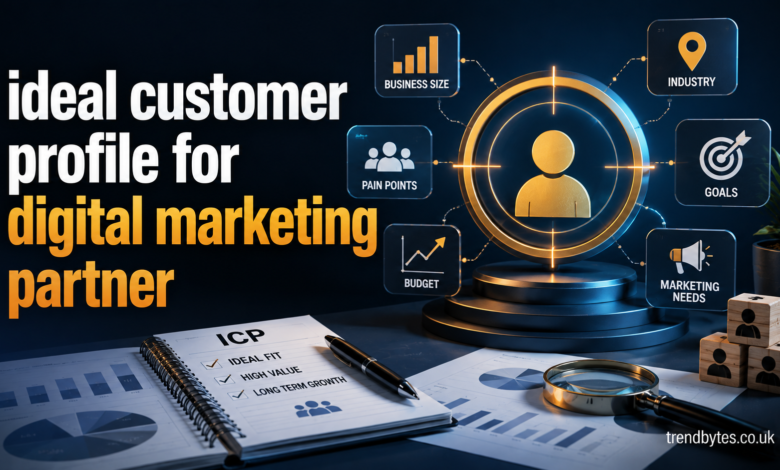
An ideal customer profile for digital marketing partner helps agencies and marketing firms identify the businesses most likely to need, value, and pay for their services. Instead of trying to attract every possible company, an ideal customer profile (ICP) defines the type of client that is the best strategic fit.
A strong ICP can improve lead quality, outreach, advertising, sales conversations, and client retention. It also helps marketing teams spend less time chasing prospects who are unlikely to become successful customers.
Whether you run an SEO agency, PPC company, content marketing firm, social media agency, or full-service digital marketing business, creating a detailed ICP gives your growth strategy a clear direction.
What Is an Ideal Customer Profile?
An ideal customer profile is a detailed description of the type of business that represents the best fit for your services.
Unlike a simple target audience, an ICP focuses on the characteristics of an organization that can benefit most from your solution and become a valuable long-term client.
For a digital marketing partner, an ICP may include:
- Industry
- Business size
- Annual revenue
- Geographic market
- Marketing budget
- Current online presence
- Website quality
- Sales model
- Growth goals
- Existing marketing team
- Decision-maker
- Main business challenges
- Technology used
- Buying behavior
For example, an SEO agency might decide that its ideal client is a growing local service business with an established website, a proven sales process, several geographic markets, and a consistent marketing budget.
That description is much more useful than simply saying, “We work with businesses.”
Why an ICP Matters for a Digital Marketing Partner
Digital marketing services can be expensive and time-consuming when they are poorly matched to a client’s needs.
An ICP helps agencies focus their resources on prospects where the relationship is more likely to produce measurable results.
Better Lead Generation
When you know exactly who you want to reach, your lead generation becomes more specific.
Instead of creating a generic campaign for “business owners,” you can target a particular type of company with a particular problem.
For example, a B2B marketing agency could focus on software companies with established sales teams that need more qualified organic leads.
More Effective Sales Conversations
A well-defined ICP also improves sales messaging.
When an agency understands a prospect’s goals and challenges, it can explain its services in business terms rather than listing generic features.
Instead of saying, “We provide SEO services,” the conversation can focus on increasing qualified organic traffic, improving visibility for commercial keywords, or creating a stronger lead pipeline.
Higher Client Retention
Good client relationships often begin with good client selection.
If a client’s expectations, budget, industry, and business model align with the agency’s capabilities, there is a better chance that both sides will understand what success looks like.
An ICP therefore supports not only acquisition but also long-term retention.
Ideal Customer Profile for Digital Marketing Partner: Key Elements
Building an effective ideal customer profile for digital marketing partner requires more than identifying an industry.
You need to understand the business from several angles.
1. Industry and Business Model
Start by identifying industries where your marketing expertise produces strong results.
Consider whether your best clients are:
- Local businesses
- E-commerce brands
- SaaS companies
- Professional services
- Healthcare organizations
- Financial services
- Home service companies
- Manufacturers
- Technology companies
- B2B companies
Then consider the business model.
A company selling high-value services may have very different marketing needs from a business selling low-cost products online.
2. Company Size and Revenue
Company size can strongly influence marketing needs and budgets.
A small local business may need foundational SEO, local search optimization, and lead generation.
A larger organization may need technical SEO, content strategy, paid advertising, conversion optimization, analytics, and marketing automation.
Revenue can also help determine whether a prospect has the resources to support an ongoing marketing program.
However, revenue should be treated as a qualification factor rather than the only measure of fit.
3. Marketing Budget
A strong digital marketing strategy requires realistic investment.
Define the minimum budget needed for your services to produce meaningful results.
For example, an agency specializing in enterprise SEO should not spend most of its sales effort targeting companies that cannot support enterprise-level campaigns.
At the same time, avoid making budget the only qualification factor. A smaller company with strong growth potential may become an excellent client.
4. Geographic Market
Location matters, especially for local SEO and location-based advertising.
Your ICP might focus on businesses operating in:
- One city
- Multiple locations
- A specific state
- A national market
- International markets
Consider whether your team has the expertise, language skills, market knowledge, and resources required to serve that geographic area.
5. Current Digital Marketing Maturity
Assess how advanced the prospect already is.
Some businesses may have no structured marketing strategy. Others may have internal marketing departments and established agencies.
Useful questions include:
- Does the business have a professional website?
- Is the website generating organic traffic?
- Does it track conversions?
- Is paid advertising already running?
- Does it publish content?
- Does it have an SEO strategy?
- Does it use analytics?
- Does it have an internal marketing team?
The answers can reveal where your services fit.
How to Build an Ideal Customer Profile
Creating an ICP becomes easier when you use a structured process.
Step 1: Analyze Your Best Existing Clients
Start with your current and previous customers.
Identify clients that produced strong results, had healthy communication, paid on time, understood the value of marketing, and stayed with your company.
Look for patterns.
Perhaps your most successful clients are mid-sized B2B companies with established websites and high customer lifetime values.
Those patterns can form the foundation of your ICP.
Step 2: Identify Their Most Valuable Problems
Your ideal customer should have a problem your business can solve well.
For example, an SEO agency may find that its strongest clients struggle with:
- Low organic visibility
- Weak commercial keyword rankings
- Poor website structure
- Limited qualified traffic
- Strong competitors
- Weak content strategy
- Low conversion rates
The more important the problem is to the prospect, the more valuable your solution becomes.
Step 3: Identify Buying Signals
Look for events that indicate a business may be ready to invest in marketing.
Buying signals can include:
- Launching a new website
- Entering a new market
- Opening new locations
- Hiring a marketing director
- Increasing advertising activity
- Launching new products
- Receiving investment
- Expanding sales teams
- Losing search visibility
- Rebranding
These signals can help sales teams prioritize prospects.
Step 4: Identify the Decision-Maker
Knowing who makes the purchasing decision is essential.
Depending on the company, the decision-maker could be:
- Founder
- CEO
- Marketing director
- CMO
- Head of growth
- E-commerce manager
- Business development director
Understand both the decision-maker and the people who influence the decision.
A marketing director may care about qualified leads and reporting, while a CEO may focus more on revenue and return on investment.
Create an ICP Scoring System
Once you define your ideal client, create a simple scoring system.
For example:
| Factor | Ideal Fit |
|---|---|
| Industry | Strong |
| Budget | Strong |
| Business Growth | Strong |
| Marketing Need | Strong |
| Decision-Maker Access | Strong |
| Geographic Fit | Strong |
| Website Potential | Strong |
| Service Compatibility | Strong |
Assign points to each factor.
A prospect with a high score can receive immediate sales attention, while a low-scoring prospect may be placed into a longer-term marketing campaign.
This approach makes lead qualification more consistent.
Real-World Example of an ICP
Imagine a digital marketing agency specializing in SEO for home service companies.
Its ideal customer could look like this:
Industry: Plumbing, HVAC, roofing, electrical, or remodeling
Company size: 10–50 employees
Market: Major US metropolitan areas
Website: Established but underperforming
Marketing problem: Strong competition and low organic visibility
Business goal: Generate more qualified leads
Budget: Able to support ongoing SEO and content work
Decision-maker: Owner, marketing manager, or general manager
Buying signal: Opening new service areas or locations
This profile gives the agency a clear audience for SEO campaigns, outbound prospecting, content, and paid advertising.
How an ICP Improves Digital Marketing Strategy
Your ICP should influence almost every part of your marketing.
Content Marketing
Create content that answers the actual questions your ideal customers ask.
If your ICP consists of B2B technology companies, your content might focus on lead generation, technical SEO, SaaS growth, customer acquisition, and conversion optimization.
SEO
Your ICP should influence keyword research.
Instead of targeting high-volume keywords that attract unrelated visitors, prioritize searches that indicate commercial intent among your ideal buyers.
Paid Advertising
Paid campaigns can use industry, company size, job roles, geographic areas, interests, and other appropriate targeting signals.
The goal is not simply to generate clicks. It is to attract qualified prospects.
Outreach
Cold outreach becomes stronger when the message reflects a prospect’s actual situation.
A personalized message can identify a specific problem, explain why it matters, and offer a relevant solution.
Common ICP Mistakes to Avoid
Making the ICP Too Broad
“Any business that needs marketing” is not an ICP.
The more specific your profile, the easier it becomes to create relevant campaigns.
Focusing Only on Demographics
Business size and location matter, but they do not tell the entire story.
Marketing maturity, pain points, buying triggers, and growth goals can be equally important.
Creating an ICP Based on Assumptions
Use real customer data whenever possible.
Review sales records, client performance, retention rates, profitability, and feedback before finalizing your profile.
Ignoring Bad-Fit Customers
Your ICP should identify who you should pursue and who you should avoid.
If certain customer types consistently have unrealistic expectations, low budgets, poor communication, or weak results, consider excluding them.
Never Updating the ICP
Markets change.
Your services may change. Your strongest industries may change. Customer needs may evolve.
Review your ICP regularly and update it when your data shows a new pattern.
Expert Tips for a Stronger ICP
Keep your ICP specific enough to guide decisions but flexible enough to capture valuable opportunities.
Separate “must-have” characteristics from “nice-to-have” characteristics.
For example, an established website may be a must-have, while a specific marketing platform may simply be preferred.
Also, connect your ICP to measurable business outcomes.
Ask whether your ideal customer has a problem that your service can solve profitably and repeatedly.
Finally, make sure your sales and marketing teams use the same definition. An ICP only works when everyone understands what a qualified prospect looks like.
People Also Ask
What is an ideal customer profile in digital marketing?
An ideal customer profile is a detailed description of the type of business that is most likely to benefit from a digital marketing service and become a valuable long-term customer.
Why does a digital marketing partner need an ICP?
An ICP helps a marketing partner target better prospects, create more relevant messaging, improve lead quality, shorten sales cycles, and build stronger long-term client relationships.
What should an ideal customer profile include?
A strong ICP can include industry, company size, revenue, location, marketing budget, business model, marketing maturity, pain points, goals, decision-makers, and buying signals.
How do you identify an ideal digital marketing client?
Analyze your best existing clients and look for common patterns in industry, profitability, retention, marketing needs, budget, business goals, and overall fit.
What is the difference between an ICP and a buyer persona?
An ICP generally describes the ideal organization or business, while a buyer persona describes an individual decision-maker or customer within that organization.
How often should an ICP be updated?
Review your ICP periodically and whenever your services, market, customer base, or business strategy changes. Use actual customer and sales data to guide updates.
Can a small business have an ideal customer profile?
Yes. In fact, an ICP can be especially useful for small agencies because it helps them focus limited sales and marketing resources on the most promising prospects.
How does an ICP improve SEO?
An ICP helps SEO teams prioritize keywords, topics, content, and search intent that are more relevant to the customers they actually want to attract rather than focusing only on search volume.
Final Thoughts
An ideal customer profile for digital marketing partner provides a practical framework for finding businesses that are genuinely aligned with your services. Instead of trying to reach everyone, you can focus on prospects with the right problems, resources, goals, and buying signals.
Start by studying your best customers. Identify what they have in common, understand the problems you solve most effectively, define the decision-makers, and establish clear qualification criteria.
Then use that profile throughout your SEO, content marketing, paid advertising, sales outreach, and lead qualification processes.
A strong ICP is not a static document. It should evolve as you gather more customer data and learn which clients generate the best results. When your ideal customer profile matches your strongest capabilities, your digital marketing strategy becomes more focused, efficient, and commercially valuable.