Sharks & Friends Shiny Memory Matching Game: A Complete Guide

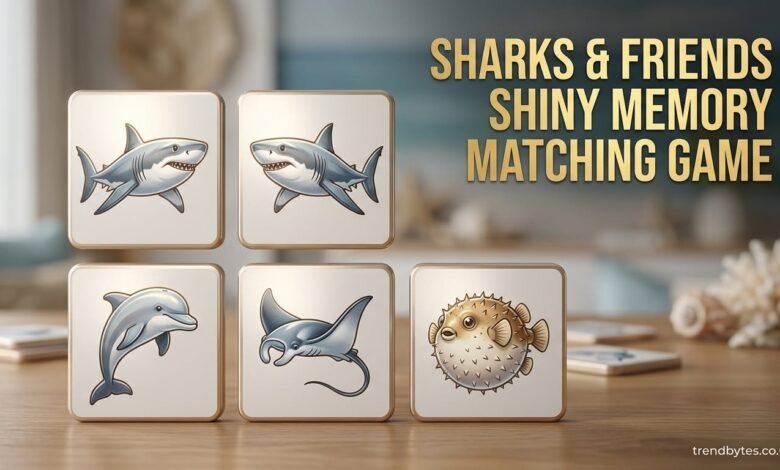
The Sharks & Friends Shiny Memory Matching Game is a colorful children’s matching game that combines classic memory play with an ocean-life theme. Designed for young children and families, it features sharks and other cartilaginous sea creatures illustrated on sturdy tiles with shiny metallic details.
The game is designed for children ages 3 and up and can be played by one to four players. It includes 48 tiles that form 24 matching pairs, along with an identification chart that introduces players to the marine creatures featured in the game.
Beyond simple entertainment, the game encourages children to practice memory, concentration, visual recognition, storytelling, and pattern matching while exploring an underwater theme.
What Is the Sharks & Friends Shiny Memory Matching Game?
The Sharks & Friends Shiny Memory Matching Game is a traditional memory-and-matching game from eeBoo with an educational ocean theme.
The basic idea is easy to understand. Players place the tiles face down and take turns turning over two tiles at a time. The goal is to remember where different images are located and find their matching pairs.
The colorful artwork and metallic foil details make the tiles visually appealing, while the shark and marine-life theme adds an educational element.
The game is suitable for family play because younger children can learn the rules quickly, while older players can make the game more challenging by using all of the tiles.
What’s Included in the Sharks & Friends Shiny Memory Matching Game?
The game includes:
- 48 sturdy matching tiles
- 24 matching pairs
- An identification chart
- Ocean and marine-life illustrations
- Metallic foil details
- Tiles measuring approximately 2.25 by 2.25 inches
- Support for 1 to 4 players
- A recommended age of 3 and up
The combination of a manageable number of components and simple rules makes it approachable for preschool-age players.
How to Play Sharks & Friends Shiny Memory Matching Game
The rules are straightforward, making the game a good choice for children who are learning how memory games work.
Start by mixing all the tiles and placing them face down on a flat surface.
Arrange them in rows so players can easily reach the cards. The exact layout can be adjusted depending on the available space and the child’s age.
The first player turns over two tiles.
If the images match, that player keeps the pair and can continue according to the agreed-upon rules.
If the tiles do not match, both are turned face down again. The next player then takes a turn.
The most important skill is remembering where previously revealed creatures were located.
The game continues until all matching pairs have been collected. The player with the most pairs wins.
How Many Players Can Play?
The game is designed for one to four players.
With two players, the game becomes a simple head-to-head memory challenge.
With three or four players, children must remember more information while also watching which pairs other players collect.
It can also be played as a solo activity. A child can turn over tiles and challenge themselves to find pairs while practicing memory and concentration.
What Makes the Game Different?
There are many memory matching games for children, but the ocean theme gives this version a distinct educational angle.
Instead of using generic pictures, the game focuses on sharks and other cartilaginous creatures.
The identification chart can encourage children to look more closely at the animals and learn that the creatures are not all the same.
This makes the game useful for parents and educators who want to combine play with basic nature and marine-life exploration.
Educational Benefits of the Game
Memory matching games can support several early learning skills.
Memory and Recall
The central challenge is remembering where particular images are located.
When a child turns over a tile and sees a creature, they must remember its position after the tile is turned back over.
As more tiles are revealed, the child builds a mental map of the playing area.
Concentration
Children need to pay attention to other players’ turns as well as their own.
Watching carefully can provide clues about where matching tiles are located.
This encourages children to stay focused rather than simply waiting for their next turn.
Pattern Recognition
Matching requires children to compare visual information.
They learn to notice similarities between images and recognize when two tiles belong together.
This type of visual comparison is an important part of early learning.
Recognition Skills
The game also provides opportunities to recognize different marine animals.
Children can look at the illustrations, compare creatures, and use the identification chart to explore what they are seeing.
Storytelling and Imagination
The underwater theme can inspire children to create stories about the creatures they find.
Parents can ask questions such as, “Where do you think this shark lives?” or “What might these animals encounter in the ocean?”
The matching game can then become a starting point for imaginative play.
Why Sharks Make an Interesting Theme for Kids
Sharks naturally attract children’s attention.
They are large, mysterious ocean animals that appear in books, documentaries, museums, and educational programs.
Using sharks as the central theme can make a basic memory game more engaging for children who already enjoy marine life.
The game also introduces children to the idea that sharks are part of a larger group of cartilaginous animals.
That can lead to simple conversations about how different sea creatures look and live.
How Long Does the Game Take?
A typical game takes around 15 to 25 minutes, although the actual playing time can vary.
Younger children may need more time to understand the rules and remember locations.
Experienced players may move more quickly.
The game length is convenient for preschool-age children because a round does not require a large block of free time.
Parents can also stop after a certain number of pairs if a child becomes tired or wants to move on to another activity.
Best Ways to Play With Younger Children
For a three-year-old, using all 48 tiles at once may create a difficult challenge.
Parents can start with a smaller number of pairs.
For example, choose six or eight pairs and place them face down. Once the child becomes comfortable with the basic rules, gradually add more pairs.
This keeps the game fun without making it unnecessarily frustrating.
Make It a Learning Activity
Parents can also turn each successful match into a short learning opportunity.
After a child finds a pair, ask them to identify the creature or describe what they notice about it.
You don’t need to turn every turn into a lesson. A few simple questions can add educational value without taking away from the fun.
Tips for Helping Children Improve Their Memory
The game provides a natural way to practice memory skills.
Encourage children to remember locations rather than simply guessing.
For example, they might mentally associate a tile with its position in the row.
You can also encourage them to describe what they saw.
Saying “the shark was in the top row” can help create a stronger memory than simply looking at the picture.
As children improve, they can begin remembering several locations at once.
Common Mistakes When Playing
Turning Over Too Many Tiles
The basic game works best when only two tiles are revealed during a turn.
Showing additional tiles can remove much of the memory challenge.
Giving Children the Answer Too Quickly
Parents may be tempted to point out where a matching tile is located.
Instead, give the child time to think.
Even an incorrect guess can be useful because it gives the child another opportunity to practice memory.
Making the Game Too Difficult
Using all the tiles immediately may frustrate younger children.
Start small and increase the number of pairs as their confidence grows.
Focusing Too Much on Winning
For young children, learning the rules and practicing memory may be more important than determining who wins.
Keep the mood positive, especially when a child is still learning.
Sharks & Friends vs. Traditional Memory Games
The basic gameplay is similar to other picture-matching games.
The main difference is the theme and presentation.
A traditional memory game might use everyday objects, animals, colors, or simple symbols.
Sharks & Friends focuses on marine creatures and adds shiny metallic details to the artwork.
The identification chart also gives the game an educational feature that can encourage children to learn more about the creatures shown on the tiles.
Is Sharks & Friends a Good Game for Preschoolers?
The game is designed for children ages 3 and up, making it appropriate for preschool-age players who are ready for simple matching activities.
However, every child develops at a different pace.
Some three-year-olds may enjoy using a smaller selection of tiles, while older children may want to use the full set.
Parents can adjust the difficulty without changing the basic rules.
That flexibility makes the game suitable for different skill levels within the recommended age range.
Is It Good for Family Game Night?
Yes, especially for families with younger children.
The rules are simple enough that adults do not need to spend a long time explaining them.
The four-player capacity also allows parents and siblings to join together.
For older children, parents can increase the challenge by encouraging them to remember multiple locations or identify creatures using the chart.
The game works best when everyone treats it as a relaxed learning activity rather than a highly competitive contest.
Sustainability and Materials
The game uses sturdy board tiles and is presented with sustainability-focused materials.
The product information describes the production as using recycled board and FSC-certified paper, with vegetable-based inks.
For families who consider environmental factors when choosing children’s products, these material choices may be an additional consideration.
As with any children’s game, proper care can also help extend the life of the tiles.
Keeping them dry, storing them in their box, and avoiding bending or rough handling can help preserve the artwork and matching surfaces.
Expert Tips for Getting More Value From the Game
One of the easiest ways to extend the game’s usefulness is to change how you play it.
For younger children, use fewer pairs.
For children who have mastered the basic game, use the full set.
You can also introduce a cooperative version in which everyone works together to find all the pairs before finishing the game.
Another option is to use the identification chart after each round and choose one or two creatures to learn about.
This transforms a short memory game into a broader ocean-learning activity.
People Also Ask
What age is the Sharks & Friends Shiny Memory Matching Game for?
The game is recommended for children ages 3 and up. Younger children can begin with fewer pairs and gradually use more tiles as their memory and matching skills develop.
How many pieces are in the Sharks & Friends memory game?
The game includes 48 sturdy tiles that form 24 matching pairs. Each tile is approximately 2.25 by 2.25 inches.
How many players can play Sharks & Friends?
The game is designed for one to four players. It can be played alone as a memory exercise or with family and friends.
How long does Sharks & Friends Shiny Memory Matching Game take?
A typical game takes approximately 15 to 25 minutes, although the length can vary depending on the number of players, age, and experience level.
What skills does Sharks & Friends develop?
The game encourages memory, concentration, visual recognition, pattern matching, storytelling, and imagination. The ocean theme can also introduce children to different marine creatures.
Is Sharks & Friends educational?
Yes. In addition to memory and matching practice, the game includes an identification chart and features sharks and other cartilaginous creatures, providing an opportunity for basic marine-life learning.
Can a three-year-old play Sharks & Friends?
Yes. The game is recommended for ages 3 and up. Parents can make it easier for younger players by starting with a small number of matching pairs.
What makes the game different from other memory matching games?
Its shark and marine-life theme, colorful illustrations, metallic foil details, and identification chart give it an educational ocean-focused presentation while keeping the familiar matching-game format.
Conclusion: Is the Sharks & Friends Shiny Memory Matching Game Worth It?
The Sharks & Friends Shiny Memory Matching Game combines a simple, familiar matching format with an engaging ocean-life theme. With 48 tiles forming 24 pairs, one to four players can practice memory and concentration while discovering illustrations of sharks and other cartilaginous creatures.
Its recommended age of 3 and up makes it particularly suitable for preschoolers and young children. The game can also be adjusted to different skill levels by starting with fewer pairs and gradually increasing the challenge.
For families looking for a screen-free activity that blends play, visual recognition, memory practice, and marine-life exploration, this game offers a practical option. The strongest way to use it is not to focus only on who wins, but to let children observe, remember, ask questions, and have fun while learning about the fascinating world beneath the water.