EEG Tech: What They Do, Salary, Training, and How to Become One

If you are interested in healthcare, technology, and working directly with patients, becoming an EEG tech can be an interesting career path. EEG techs operate specialized equipment that records electrical activity in the brain and helps medical teams investigate neurological conditions.
The career combines patient care, medical technology, attention to detail, and clinical procedures. It can also provide a pathway into broader careers in neurodiagnostic technology and other healthcare specialties.
This guide explains what an EEG tech does, how to become one, what training you may need, salary factors, certification, daily responsibilities, and what to expect from the job.
What Is an EEG Tech?
An EEG tech, also called an electroencephalographic technologist or EEG technician, is a healthcare professional who performs electroencephalography tests.
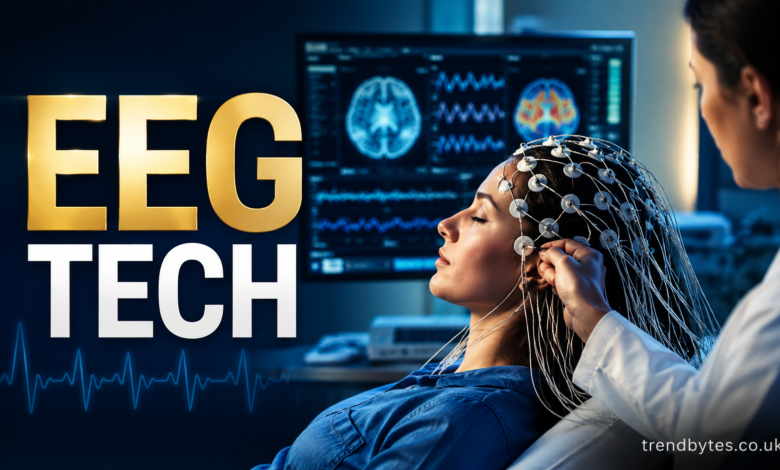
An EEG records electrical signals produced by brain activity. During a test, the EEG tech places electrodes on the patient’s scalp and connects them to specialized recording equipment.
The resulting information is reviewed by qualified medical professionals, such as neurologists, who use it as part of a patient’s overall clinical evaluation.
An EEG tech does not diagnose a neurological disorder based on the test. Instead, the technologist’s role is to obtain accurate, high-quality recordings and document relevant observations for the healthcare team.
What Does an EEG Tech Do?
The daily work of an EEG tech involves much more than attaching electrodes. Technologists interact with patients, prepare equipment, follow testing protocols, monitor recordings, and maintain accurate documentation.
Typical responsibilities include:
- Explaining the EEG procedure to patients
- Preparing patients for testing
- Measuring and marking the scalp according to established protocols
- Applying EEG electrodes
- Connecting patients to EEG recording equipment
- Checking signal quality and reducing technical interference
- Monitoring patients throughout the examination
- Performing routine and specialized EEG procedures
- Documenting patient information and test observations
- Cleaning and maintaining equipment
- Communicating important observations to the appropriate clinical staff
In some healthcare settings, EEG technologists may also assist with longer-term monitoring or tests performed in specialized neurological units.
EEG Tech During a Typical Patient Test
A typical EEG appointment starts with patient preparation.
The technologist may explain what will happen, review relevant information, and prepare the patient’s scalp. Electrodes are then placed using standardized measurements so that the recording accurately represents brain activity.
Once the recording begins, the EEG tech monitors the equipment and watches for technical problems. Depending on the protocol, the patient may be asked to open and close their eyes, breathe deeply, or respond to other instructions.
After the test, the equipment is removed and the patient’s information is documented. The recording is then made available for professional interpretation.
How to Become an EEG Tech
The path to becoming an EEG tech can vary depending on the employer, location, education program, and certification requirements.
However, the general process involves education, clinical training, hands-on experience, and potentially professional certification.
1. Earn a High School Diploma or Equivalent
Most healthcare training programs require a high school diploma or equivalent qualification.
Courses in biology, anatomy, mathematics, computer science, and health sciences can provide useful preparation.
Strong communication skills are also important because EEG techs work closely with patients and healthcare professionals.
2. Complete EEG Training
Many aspiring technologists complete an accredited or recognized neurodiagnostic technology program.
Training can cover subjects such as:
- Human anatomy and physiology
- Neurology
- Neurodiagnostic procedures
- EEG equipment operation
- Electrode placement
- Patient safety
- Medical terminology
- Infection control
- Clinical documentation
- Troubleshooting technical problems
Hands-on clinical experience is especially valuable because EEG testing requires precision and patient interaction.
3. Gain Clinical Experience
Clinical training allows students to practice procedures under supervision.
This experience helps future technologists become comfortable with electrode placement, equipment setup, patient communication, recording techniques, and troubleshooting.
Real-world experience also teaches an important lesson: every patient and every recording can present different challenges.
4. Consider Professional Certification
Certification can demonstrate knowledge and technical competency.
Requirements vary by credential and location, so students should check the current requirements for the certification they plan to pursue.
Certification may also improve professional credibility and help candidates qualify for certain positions.
EEG Tech Education Requirements
There is no single educational route that applies to every EEG tech position.
Some employers may accept candidates with specific neurodiagnostic training, while others may prefer formal education combined with clinical experience and certification.
A specialized training program can be especially useful because EEG work involves technical procedures that are difficult to learn through general healthcare education alone.
When comparing programs, look at:
- Clinical training opportunities
- Program length
- Curriculum
- Accreditation or recognition
- Certification preparation
- Graduate outcomes
- Employer partnerships
- Total program cost
Choosing a program based only on price or completion speed can be a mistake. Practical training is one of the most important parts of preparation for this career.
EEG Tech Salary: What Can You Expect?
The salary of an EEG tech varies considerably.
Factors that can affect earnings include experience, certification, geographic location, employer, hospital size, shift schedule, specialty training, and level of responsibility.
Entry-level technologists generally earn less than experienced professionals. Technologists working in larger medical centers or specialized neurological departments may have different earning opportunities than those working in smaller facilities.
Overtime, night shifts, weekends, and other scheduling factors can also affect total compensation.
Instead of focusing on one national salary number, prospective EEG techs should research local job postings and compare compensation packages in the area where they plan to work.
Benefits matter too. A job offering health insurance, retirement contributions, paid time off, education assistance, and shift differentials may be more valuable than a position with a slightly higher base wage.
Where Do EEG Techs Work?
EEG techs commonly work in healthcare environments where neurological testing is performed.
Potential workplaces include:
- Hospitals
- Neurology departments
- Medical centers
- Outpatient clinics
- Children’s hospitals
- Epilepsy monitoring units
- Specialized neurological facilities
- Sleep and neurodiagnostic centers
The work environment can differ significantly from one facility to another.
A hospital position may involve patients with urgent neurological concerns, while an outpatient clinic may have a more predictable schedule.
What Skills Does an EEG Tech Need?
Technical knowledge is essential, but successful EEG techs also need strong interpersonal skills.
Important skills include:
Attention to detail: Small technical problems can affect recording quality, so careful work matters.
Communication: Patients may feel nervous about neurological testing. Clear explanations can make the experience easier.
Patience: Some patients may have difficulty remaining still or following instructions.
Technical ability: EEG equipment and software require careful operation and troubleshooting.
Critical observation: Technologists need to recognize technical issues and document relevant observations accurately.
Professionalism: EEG techs work with sensitive patient information and must follow appropriate clinical procedures.
Common EEG Tech Career Challenges
Like any healthcare career, EEG technology has challenges.
Patients may be anxious, uncomfortable, confused, or unable to cooperate fully. Some examinations can also take considerable time, particularly when extended monitoring is required.
Technologists may work weekends, nights, or on-call shifts depending on the facility.
Another challenge is maintaining technical accuracy. Poor electrode placement, movement, electrical interference, or equipment problems can reduce the usefulness of a recording.
For this reason, attention to detail is not optional. It is a core part of the profession.
EEG Tech vs. Other Neurodiagnostic Careers
EEG technology is one part of the broader neurodiagnostic field.
Related career paths can include roles involving nerve conduction studies, evoked potentials, long-term neurological monitoring, and other diagnostic procedures.
Some professionals eventually expand their training and develop expertise across multiple neurodiagnostic modalities.
This can make the field attractive to people who want a healthcare career with opportunities to build additional technical skills over time.
Best Practices for Aspiring EEG Techs
If you are considering this career, start preparing before applying for jobs.
First, research the requirements of healthcare employers in your area. Job requirements can reveal which education and certifications are most valuable.
Next, look for programs that provide meaningful clinical experience rather than focusing only on classroom instruction.
It is also helpful to develop strong anatomy and physiology knowledge. Understanding the body makes technical procedures easier to understand.
Finally, practice professional communication. An EEG tech may spend a large portion of the day explaining procedures and helping patients feel comfortable.
Expert Tip: Focus on Clinical Quality
One of the best ways to stand out is to become highly reliable with basic procedures.
Accurate patient identification, careful preparation, correct electrode placement, clean documentation, equipment checks, and professional communication create a strong foundation for more advanced work.
Common Mistakes to Avoid
Choosing a Program Without Checking Its Recognition
Do not assume every training program provides the same professional value. Investigate the program’s curriculum, clinical opportunities, and relationship to certification requirements.
Focusing Only on Salary
Salary is important, but it should not be the only factor. Consider work environment, schedule, benefits, career growth, commute, and training opportunities.
Ignoring Patient Communication
EEG technology is technical, but it is also patient-facing. A technically skilled professional who cannot communicate clearly may struggle in clinical practice.
Neglecting Equipment Troubleshooting
Knowing how to identify artifacts and technical problems is an important part of producing useful recordings.
Stopping Professional Development
Healthcare technology continues to evolve. Continuing education can help technologists maintain their skills and adapt to new equipment, procedures, and clinical practices.
Is Being an EEG Tech a Good Career?
For the right person, becoming an EEG tech can be a rewarding healthcare career.
It may suit people who enjoy medical technology but also want regular patient interaction. The work requires precision, responsibility, patience, and a willingness to learn.
It can also provide opportunities to gain experience in neurology and explore related neurodiagnostic specialties.
However, prospective students should understand that this is clinical work. The job can involve stressful situations, difficult patients, extended procedures, and irregular schedules.
Before committing to a program, consider whether the daily responsibilities match your interests and personality.
People Also Ask About EEG Tech Careers
What does an EEG tech do?
An EEG tech prepares patients, applies electrodes, operates EEG equipment, monitors recordings, troubleshoots technical problems, and documents the procedure. A qualified medical professional interprets the results.
How long does it take to become an EEG tech?
The timeline depends on the educational route, clinical training requirements, employer expectations, and certification pathway. Some programs are relatively short, while others involve more extensive education and clinical preparation.
Is EEG tech a good career?
It can be a good career for people interested in healthcare, neurology, technology, and direct patient care. Career satisfaction depends on the work environment, schedule, compensation, and personal interests.
Do EEG techs work in hospitals?
Yes. Hospitals are common workplaces for EEG technologists. They may work in neurology departments, epilepsy monitoring units, intensive care settings, or other clinical areas.
Do EEG techs need certification?
Certification requirements vary by location and employer. Even when certification is not legally required for every position, professional credentials can demonstrate competency and may improve employment opportunities.
Is EEG technology difficult to learn?
The technical aspects require practice, especially electrode placement, recording quality, artifact recognition, and equipment troubleshooting. Strong training and supervised clinical experience can make the learning process much easier.
What skills are important for an EEG tech?
Important skills include attention to detail, communication, patient care, technical troubleshooting, organization, professionalism, and an understanding of anatomy and neurological testing.
Can an EEG tech advance their career?
Yes. Experienced technologists may pursue additional credentials, specialized neurodiagnostic training, leadership responsibilities, or related healthcare roles depending on their education and professional goals.
Final Thoughts on Becoming an EEG Tech
Becoming an EEG tech can be a strong option for someone who wants to combine healthcare, technology, and patient care. The role requires more than operating equipment: it demands accurate technical work, careful observation, compassion, and professional communication.
The best starting point is to research recognized training options, understand local employer requirements, and seek meaningful clinical experience. From there, certification and continued professional development can help build credibility and expand career opportunities.
If you enjoy medical technology and have an interest in the brain and nervous system, EEG technology may be a career path worth exploring. With the right training and a commitment to clinical quality, an EEG tech can play an important role in the neurological care team.