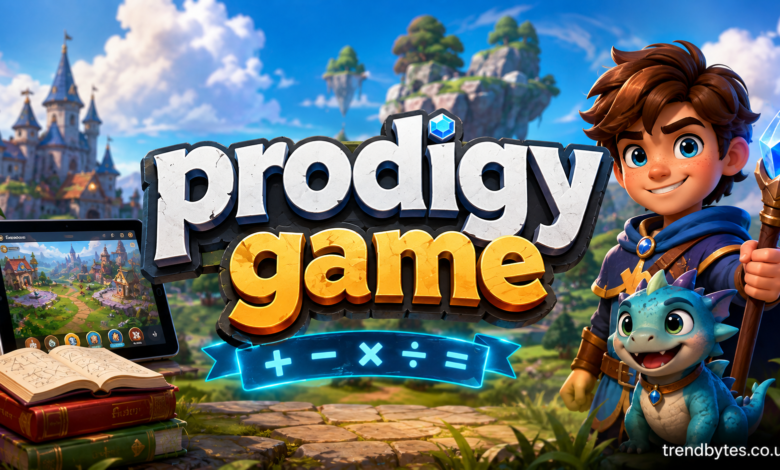
The prodigy game combines math practice with an adventure-style gaming experience designed to make learning more engaging for children. Instead of completing traditional worksheets, students can answer math questions while exploring a virtual world, completing quests, collecting items, and developing their characters.
For parents and teachers, the appeal is simple: students can practice important math skills in a format that feels more like a game than conventional schoolwork. However, understanding how the platform works, what students can learn, and how to use it effectively is important before making it part of a child’s learning routine.
What Is Prodigy Game?
Prodigy is an educational math game built around a fantasy adventure environment. Students create or customize a character and explore a virtual world while completing activities that include math questions.
The educational content is connected to math skills and can be adapted to a student’s level. Depending on the student’s grade and learning goals, questions may cover areas such as addition, subtraction, multiplication, division, fractions, decimals, geometry, and other mathematical concepts.
The game-based format is designed to encourage repeated practice. Instead of simply answering questions on a worksheet, students receive game-related rewards and progress through an interactive environment.
How Does the Prodigy Game Work?
The basic concept is straightforward.
A student enters the game world, participates in activities, and encounters math challenges. Correct answers help the student progress, while the surrounding game mechanics provide motivation to continue practicing.
A typical experience may involve:
- Creating and customizing a character
- Exploring different areas
- Completing quests
- Answering math questions
- Earning rewards
- Unlocking game content
- Practicing grade-level math skills
- Tracking educational progress
The important distinction is that the math questions are not simply an extra feature. They are integrated into the gameplay itself.
Prodigy Game for Different Grade Levels
The platform is primarily designed for elementary and middle-school learners, with mathematical content organized around different levels of difficulty.
For younger students, activities may focus on foundational arithmetic and number skills. Older students can encounter more advanced concepts as their learning needs increase.
Parents should still consider whether the assigned content matches the child’s current abilities. A game can be engaging, but the educational value is strongest when the difficulty is appropriate.
Key Features of Prodigy Game
Interactive Math Practice
One of the main strengths of the platform is its interactive approach to math practice.
Students do not simply receive a list of problems. They answer questions as part of a larger game environment, which can make repetitive practice feel more engaging.
Character Customization
Students can personalize aspects of their game experience and character. This gives them a sense of ownership and provides another reason to return to the game.
For children who enjoy customization and collecting virtual items, this feature can add motivation.
Quests and Adventures
The adventure structure gives students goals beyond simply answering individual math questions.
Quests can provide a sense of progression, helping children understand that completing smaller activities contributes to a larger objective.
Teacher Assignments
Teachers can use educational features to support classroom instruction and assign or monitor math practice.
This can make the platform useful as a supplement to lessons rather than a replacement for direct teaching.
Parent Features
Parents can use available account features to gain insight into a child’s learning activity and progress.
This can help families understand which areas a student is practicing and where additional support may be useful.
Benefits of Prodigy Game for Students
1. Makes Math Practice More Engaging
One of the biggest challenges with math practice is motivation.
A student who dislikes worksheets may be more willing to practice when questions are part of an adventure. The game environment can make repetition feel less routine.
2. Encourages Regular Practice
Math skills improve through consistent practice.
A game-based system can encourage students to return regularly and work through additional questions instead of practicing only before a test.
3. Provides Immediate Feedback
Interactive learning can provide feedback shortly after a student answers a question.
Immediate feedback is useful because students can recognize mistakes while the concept is still fresh.
4. Supports Independent Learning
Once students understand how the game works, they can often complete activities with limited assistance.
This can encourage children to become more comfortable working independently.
5. Adds Motivation Through Game Mechanics
Rewards, progress, customization, and exploration can provide additional motivation.
These mechanics do not replace good instruction, but they can make practice more appealing.
Is Prodigy Game Good for Learning Math?
Prodigy can be a useful supplemental learning tool, but it should not be viewed as a complete replacement for teaching, textbooks, problem-solving activities, or real-world practice.
Math learning involves more than getting answers correct. Students also need to understand why an answer is correct, explain their reasoning, apply concepts to unfamiliar problems, and develop problem-solving strategies.
For example, a student might correctly solve several multiplication questions in a game but still struggle to explain how multiplication relates to repeated addition.
That is why the best approach is to combine game-based practice with discussion, instruction, written work, and practical examples.
How Parents Can Get More Value From Prodigy Game
Set Clear Screen-Time Expectations
Gaming can become distracting if there are no boundaries.
Parents can establish a specific time or routine for educational gameplay. For example, a child might use the game after completing homework or during a scheduled practice period.
The goal is to make the game part of a balanced routine.
Talk About the Math
Do not focus only on how far the child progresses in the game.
Ask questions such as:
- What math problem did you solve today?
- Which question was difficult?
- How did you find the answer?
- Can you explain another way to solve it?
These conversations can turn game activity into deeper learning.
Focus on Skills, Not Rewards
Virtual rewards can be motivating, but the primary goal should remain mathematical improvement.
Parents can praise effort, persistence, and understanding rather than focusing entirely on virtual items or game achievements.
How Teachers Can Use Prodigy Effectively
Teachers can use game-based math practice as one part of a broader instructional strategy.
For example, a teacher might introduce fractions during a classroom lesson, demonstrate several examples, provide hands-on activities, and then use digital practice to reinforce the same skills.
This creates a connection between instruction and independent practice.
Teachers should also review student performance when possible. If several students struggle with the same concept, that may indicate a need for additional classroom instruction.
Common Mistakes to Avoid
Using the Game as a Complete Math Curriculum
An educational game should support learning rather than replace thoughtful teaching.
Students still need direct instruction, written practice, discussion, and opportunities to solve problems without game assistance.
Ignoring the Child’s Actual Skill Level
If activities are far too easy, students may not develop new skills. If they are too difficult, frustration can reduce motivation.
The most useful practice is challenging without becoming overwhelming.
Focusing Only on Game Progress
A child can become very interested in collecting items or completing quests.
Parents and teachers should keep the educational purpose in view and encourage students to think about the math behind the gameplay.
Allowing Unlimited Screen Time
Even educational games should be balanced with sleep, physical activity, reading, social interaction, homework, and other offline activities.
Best Practices for Using Prodigy Game
To get better results, consider these practical strategies:
- Connect gameplay to current math lessons.
- Set reasonable screen-time boundaries.
- Encourage students to explain their answers.
- Review areas where mistakes occur frequently.
- Combine digital practice with offline math activities.
- Celebrate improvement rather than only high scores.
- Adjust practice based on the student’s current skill level.
- Keep learning goals more important than game rewards.
Prodigy Game vs. Traditional Math Practice
Traditional worksheets have advantages. They can provide focused practice, allow students to show their working, and make it easy for teachers to review written reasoning.
A game offers a different experience. It can increase engagement, provide an interactive environment, and encourage repeated practice.
Neither approach needs to replace the other.
A strong learning routine can use both. For example, a student could learn a new concept from a teacher, practice several problems on paper, use the game for additional reinforcement, and then complete a real-world activity involving the same concept.
This combination provides variety while keeping the underlying learning objective clear.
Tips for Students Using Prodigy Game
Students can make their practice more effective by slowing down and reading each question carefully.
Do not guess repeatedly just to move forward. If a question is difficult, stop and think about the mathematical concept involved.
It can also help to keep a notebook nearby. Writing down calculations, multiplication facts, fraction comparisons, or other working can improve understanding.
Most importantly, treat mistakes as part of learning. Getting an answer wrong can reveal exactly which concept needs more practice.
Frequently Asked Questions About Prodigy Game
What is Prodigy Game used for?
Prodigy is used primarily for interactive math practice. It combines curriculum-related math questions with an adventure-style game environment to encourage students to practice mathematical skills.
What age is Prodigy Game for?
Prodigy is designed mainly for school-age children, particularly elementary and middle-school students. The appropriate experience depends on the child’s grade, math ability, and learning needs.
Is Prodigy Game educational?
Yes. Its core gameplay incorporates math questions and practice. However, it works best as a supplement to broader math instruction rather than as the only learning method.
Can teachers use Prodigy Game in the classroom?
Teachers can incorporate Prodigy into classroom learning and assign digital math practice where appropriate. It can be particularly useful for reinforcing skills introduced during instruction.
Can parents monitor a child’s progress?
Parent-focused features can provide information about a child’s learning activity and progress, depending on the account and features available.
Does Prodigy replace math homework?
It should not automatically be considered a replacement for all math homework. Teachers and parents can use it alongside written assignments, lessons, reading, and other learning activities.
How can children get better at math while playing Prodigy?
Children should focus on understanding the questions rather than rushing through them. Writing down calculations, reviewing mistakes, and discussing difficult concepts can make game-based practice more effective.
Is game-based learning effective for math?
Game-based learning can increase engagement and provide additional opportunities for practice. Its effectiveness depends on how well the game supports the learner’s goals and how it is combined with other forms of instruction.
Conclusion
The prodigy game offers an engaging way for children to practice math through an interactive adventure environment. Its combination of mathematical questions, exploration, rewards, and progression can make repeated practice more appealing to students who may find traditional worksheets less motivating.
However, the strongest results come from using it as part of a balanced learning strategy. Parents and teachers should connect gameplay to real math concepts, monitor progress, encourage students to explain their reasoning, and maintain reasonable screen-time boundaries.
Ultimately, the value of the prodigy game is not simply how long a student plays or how many virtual rewards they collect. Its real value comes from whether the experience helps a child build confidence, practice important skills, understand mathematical ideas, and become a more independent learner.