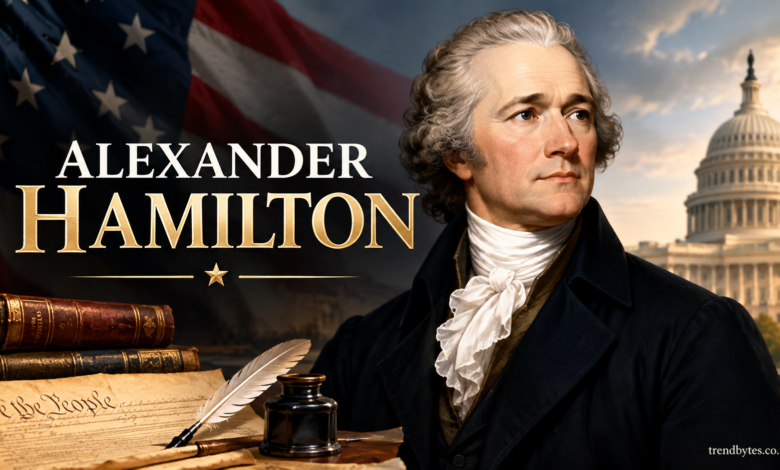
Alexander Hamilton was one of the most important figures in early American history. Born on a Caribbean island and raised in difficult circumstances, he became a key leader in the American Revolution, a trusted aide to George Washington, and the first United States Secretary of the Treasury.
His work helped shape America’s government, financial system, and national identity. He also became known for his sharp political debates, ambitious ideas, and tragic death in a duel with Aaron Burr.
But who was Alexander Hamilton, and why does his name still matter today? This guide explores his early life, role in the Revolution, political beliefs, major achievements, and lasting legacy.
Who Was Alexander Hamilton?
Alexander Hamilton was an American Founding Father, military officer, lawyer, and statesman. He played a central role in creating the United States Constitution and establishing the country’s early financial system.
He was born in the Caribbean and later moved to North America, where he pursued education and became involved in the struggle for American independence.
Hamilton believed that a strong national government was necessary for the new country to survive. He supported a national bank, federal taxation, and a stable financial system.
Alexander Hamilton at a Glance
| Detail | Information |
|---|---|
| Full name | Alexander Hamilton |
| Born | January 11, 1755, or 1757 |
| Birthplace | Nevis, British West Indies |
| Died | July 12, 1804 |
| Deathplace | New York City |
| Known for | Founding Father and first Treasury Secretary |
| Wife | Elizabeth Schuyler Hamilton |
| Political affiliation | Federalist |
| Famous opponent | Aaron Burr |
| Major achievement | Establishing the early US financial system |
The exact year of Hamilton’s birth is uncertain. Historical records and later accounts support both 1755 and 1757.
Early Life and Education
Alexander Hamilton was born on the island of Nevis in the British West Indies. His parents were Rachel Faucette and James A. Hamilton.
His childhood was difficult. His father left the family, and his mother died when Hamilton was still young. As a result, he had to face serious financial and personal challenges early in life.
Despite these hardships, Hamilton showed remarkable intelligence and ambition.
How Alexander Hamilton Came to America
Hamilton worked as a clerk in St. Croix, where he developed strong writing and business skills. A powerful hurricane struck the island in 1772, and Hamilton wrote a detailed account of the disaster.
Local community leaders were impressed by his writing. They helped raise money to send him to North America for education.
He eventually arrived in the American colonies and attended King’s College in New York, now known as Columbia University.
His education helped prepare him for a career in law, politics, and public service.
Alexander Hamilton and the American Revolution
When tensions between the American colonies and Britain increased, Hamilton became a strong supporter of independence.
He believed the colonies needed to resist British control and create a government capable of protecting their freedom.
Military Service
Hamilton joined the American Revolutionary cause and became an artillery officer in the Continental Army.
He fought in important battles and gained a reputation for courage and leadership.
His military service brought him to the attention of George Washington, who recognized Hamilton’s abilities.
In 1777, Hamilton became one of Washington’s trusted aides. He served as a senior military secretary and helped manage important communications during the war.
Although he wanted a field command, his work with Washington gave him valuable experience in leadership and government.
The Battle of Yorktown
Hamilton eventually received a combat command.
During the Battle of Yorktown in 1781, he led American troops in an attack against British positions. The victory helped force the British surrender and became a major turning point in the Revolutionary War.
Hamilton’s service during the Revolution strengthened his reputation as a capable military leader.
Alexander Hamilton and the Constitution
After the Revolutionary War, the United States faced serious problems.
The national government had limited power, the economy was weak, and the states often disagreed about taxes, trade, and public finances.
Hamilton believed the country needed a stronger federal government.
The Federalist Papers
Hamilton helped write The Federalist Papers, a collection of essays supporting the ratification of the US Constitution.
He worked with James Madison and John Jay to explain why the proposed Constitution would help create a more stable nation.
Hamilton wrote many of the essays, including important arguments about executive power, federal authority, and the need for an effective national government.
The essays remain important historical documents because they explain how some of the Constitution’s supporters understood the proposed system.
Hamilton’s View of Government
Hamilton supported:
- A strong federal government.
- A national financial system.
- Federal authority over national economic matters.
- A stable relationship between the government and public creditors.
- A stronger executive branch.
His views often brought him into conflict with Thomas Jefferson and other leaders who favored greater state power.
Alexander Hamilton as the First Secretary of the Treasury
One of Hamilton’s most important achievements came after George Washington became president.
In 1789, Washington appointed Hamilton as the first Secretary of the Treasury.
Hamilton faced a major challenge: the new nation had large debts from the Revolutionary War and needed a reliable way to fund its government.
Hamilton’s Financial Plan
Hamilton proposed a series of financial reforms designed to strengthen the United States.
His plan included:
- Federal assumption of state debts from the Revolution.
- Funding national debt through government bonds.
- Creating a national bank.
- Establishing reliable federal revenue.
- Supporting manufacturing and economic growth.
These ideas helped shape the early financial structure of the United States.
The First Bank of the United States
Hamilton supported the creation of the First Bank of the United States in 1791.
The bank was intended to help the federal government manage money, collect taxes, and support public credit.
Hamilton believed that a national bank would make the financial system more stable.
However, Thomas Jefferson and James Madison opposed the bank, arguing that the Constitution did not clearly grant Congress the power to create it.
The disagreement became one of the first major debates over the meaning of federal power.
Hamilton’s Economic Vision
Hamilton believed the United States should develop its own industries rather than depend heavily on foreign goods.
He supported manufacturing, trade, and a strong national economy.
His 1791 Report on the Subject of Manufactures explained why the government should encourage American manufacturing.
Many of his ideas influenced later debates about industrial development and economic policy.
Alexander Hamilton and Thomas Jefferson
Hamilton and Thomas Jefferson were two of the most influential leaders in the early United States.
However, they had very different ideas about how the country should be governed.
Key Political Differences
| Issue | Alexander Hamilton | Thomas Jefferson |
|---|---|---|
| Government | Strong federal government | Greater state power |
| Economy | Finance, manufacturing, commerce | Agriculture and farming |
| Political outlook | Federalist | Democratic-Republican |
| National bank | Supported | Opposed |
| Interpretation of Constitution | Broad federal powers | More limited federal powers |
Hamilton favored a more centralized government. Jefferson was concerned that too much federal power could threaten individual liberty and state authority.
Their disagreements helped shape America’s first political party system.
The Birth of Political Parties
Hamilton’s supporters became associated with the Federalist Party.
Jefferson’s supporters formed the Democratic-Republican Party.
These early political divisions influenced the country’s debates over government power, economic policy, and foreign relations.
Alexander Hamilton and Aaron Burr
Alexander Hamilton’s relationship with Aaron Burr became one of the most famous conflicts in American history.
Burr was a lawyer, politician, and vice president of the United States under Thomas Jefferson.
Hamilton and Burr had different political goals and often competed for influence.
The Duel of 1804
In 1804, Burr challenged Hamilton to a duel after a long period of political conflict and personal hostility.
The duel took place on July 11, 1804, in Weehawken, New Jersey.
Hamilton was shot by Burr and died the following day, July 12, 1804, in New York City.
He was 47 or 49 years old, depending on his birth year.
Why Hamilton’s Death Mattered
Hamilton’s death shocked the young nation.
He had played a major role in the Revolution, the Constitution, and the development of America’s financial system.
His death ended the career of one of the country’s most influential early leaders.
Aaron Burr’s political career also suffered serious damage because of the duel.
Alexander Hamilton’s Family
Hamilton married Elizabeth Schuyler in 1780.
She came from a prominent New York family, and her father was General Philip Schuyler.
The couple had eight children.
Elizabeth supported Hamilton through his political career and later worked to preserve his legacy after his death.
Elizabeth Schuyler Hamilton’s Role
Elizabeth Hamilton helped preserve her husband’s writings and historical reputation.
She also supported charitable work and was involved in efforts connected to education and care for children.
Her work helped keep Hamilton’s contributions known to later generations.
Major Achievements of Alexander Hamilton
Hamilton’s influence extended across military, political, and economic life.
1. Helped Establish the US Financial System
His financial reforms helped organize federal debt and public credit.
2. Supported the US Constitution
Through his writing and political efforts, he helped promote ratification of the Constitution.
3. Served as the First Treasury Secretary
He created important foundations for the Treasury Department and federal financial policy.
4. Helped Build a Stronger Federal Government
His ideas influenced the development of federal authority in the early republic.
5. Contributed to American Manufacturing Policy
His economic writings encouraged the growth of American industry.
Common Misconceptions About Alexander Hamilton
Several myths about Hamilton have become popular over time.
Was Hamilton Born in the United States?
No. Hamilton was born in the Caribbean, in the British West Indies.
He later moved to North America and became a leading American statesman.
Was Hamilton a President?
No. Alexander Hamilton never served as president of the United States.
He was a major adviser to George Washington and served as the first Secretary of the Treasury.
Did Hamilton Write the Entire Constitution?
No. Hamilton was an important supporter of the Constitution, but he did not write the entire document.
He helped explain and defend it through The Federalist Papers.
Was Hamilton a Founding Father?
Yes. Hamilton is widely recognized as one of America’s Founding Fathers because of his role in the Revolution, Constitution, and early federal government.
Alexander Hamilton’s Legacy Today
Hamilton’s ideas continue to influence American history and politics.
His financial reforms helped shape the nation’s early government. His writings remain important for understanding the Constitution and the debates that surrounded its creation.
His life has also become part of popular culture.
Hamilton: The Musical
The Broadway musical Hamilton, created by Lin-Manuel Miranda, brought renewed attention to Hamilton’s life.
The musical explores his immigration story, political career, relationships, and death.
It also introduced his story to many people who may not have studied him in depth.
While the musical is based on historical events, it includes artistic choices and dramatization.
For students and history readers, it can be a starting point for learning more about the actual historical figure.
Expert Tips for Studying Alexander Hamilton
If you want to understand Hamilton’s life more deeply, focus on the connection between his personal experiences and political ideas.
Tip 1: Study His Early Life
His difficult childhood helps explain his ambition and drive.
Tip 2: Understand the Constitution Debate
The Federalist Papers provide insight into his views on government.
Tip 3: Learn About His Financial Plan
His Treasury reforms are central to understanding his importance in American history.
Tip 4: Compare Hamilton and Jefferson
Their disagreements explain the development of America’s first political parties.
Tip 5: Separate History From Drama
Popular stories can be engaging, but historical documents provide a clearer picture of what actually happened.
People Also Ask About Alexander Hamilton
1. Who was Alexander Hamilton?
Alexander Hamilton was a Founding Father of the United States, a Revolutionary War officer, a major supporter of the Constitution, and the first Secretary of the Treasury.
2. What is Alexander Hamilton famous for?
He is famous for helping create America’s financial system, supporting the Constitution, writing The Federalist Papers, and serving as George Washington’s Treasury Secretary.
3. How did Alexander Hamilton die?
Hamilton died after being shot in a duel with Aaron Burr on July 11, 1804. He died the next day in New York City.
4. Was Alexander Hamilton a president?
No. Hamilton was never president. He served as the first Secretary of the Treasury under President George Washington.
5. Did Alexander Hamilton support the Constitution?
Yes. Hamilton strongly supported ratification of the US Constitution and helped write The Federalist Papers.
6. What was Hamilton’s political party?
Hamilton was associated with the Federalist Party, which supported a strong federal government.
7. Who was Alexander Hamilton’s wife?
His wife was Elizabeth Schuyler Hamilton. They married in 1780 and had eight children.
8. Why is Alexander Hamilton important today?
Hamilton remains important because his ideas influenced the Constitution, federal government, public finance, and American economic development.
Conclusion
Alexander Hamilton was a remarkable figure in American history. From his difficult childhood in the Caribbean to his work as a soldier, constitutional writer, and Treasury Secretary, his life was filled with major achievements and serious challenges.
His financial reforms helped shape the early United States, while his political debates influenced the country’s government for generations.
Although Hamilton died young in a duel with Aaron Burr, his legacy continued through his writings, policies, and family.
Understanding Alexander Hamilton means understanding a major part of America’s founding story. His life shows how ambition, political ideas, and public service can influence the direction of a nation.