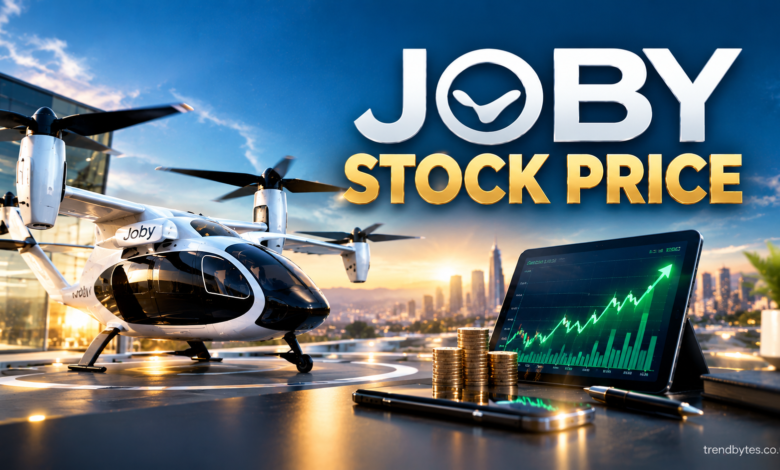
The joby stock price has become a closely watched figure as investors assess the future of electric air taxis, advanced aviation, and urban transportation. Joby Aviation, Inc. trades on the New York Stock Exchange under the ticker JOBY and is developing electric vertical takeoff and landing aircraft, commonly called eVTOLs.
The latest completed trading session on October 7, 2026, saw JOBY close at about $5.71, after trading between roughly $5.58 and $5.74 during the session. The stock has experienced significant volatility, making its daily price only one part of the larger investment story.
For investors, the bigger questions are whether Joby can complete aircraft certification, scale manufacturing, launch commercial service, generate sustainable revenue, and eventually turn its air-taxi technology into a profitable transportation business.
Joby Stock Price and Recent Performance
JOBY has been a highly volatile growth stock because much of its long-term value depends on future commercial execution rather than mature earnings.
During the first week of October 2026, the stock traded around the $5.70 to $5.95 range. Historical data shows that JOBY’s 52-week trading range has been substantially wider, highlighting the uncertainty and speculative nature of the company.
This type of volatility is common among emerging technology companies. Investors may react sharply to certification updates, production milestones, partnerships, cash-flow expectations, government programs, and changes in the broader market’s appetite for growth stocks.
As a result, someone researching JOBY should look beyond a single day’s movement.
What Is Joby Aviation?
Joby Aviation is developing all-electric vertical takeoff and landing aircraft for commercial passenger transportation.
The company’s vision is to provide fast, quiet air-taxi services in cities and other high-demand transportation markets. It also plans to sell aircraft to selected operators and partners as its business develops.
Unlike a traditional airline, Joby’s long-term model is centered on electric aircraft, vertical takeoff and landing, and short urban or regional trips.
The company is therefore competing in an emerging market rather than an established commercial aviation category.
Why Is Joby Stock Getting Attention?
Several factors are driving investor interest in Joby.
The first is the potential size of the urban air-mobility market. If eVTOL aircraft become commercially viable, they could provide an alternative to ground transportation for certain routes.
The second is Joby’s progress toward regulatory certification.
The third is manufacturing. Designing an aircraft is only one part of the challenge. A company must also produce aircraft at sufficient scale, maintain quality, secure suppliers, and operate them safely.
Finally, investors are watching whether Joby can turn demonstrations and early commercial activity into recurring revenue.
Joby Stock Price and eVTOL Growth
The eVTOL industry remains an emerging transportation category.
Electric aircraft could potentially offer lower local emissions and quieter operation than conventional helicopters, while vertical takeoff could allow them to operate from relatively compact locations.
However, the industry still faces major hurdles involving certification, infrastructure, public acceptance, operating economics, battery technology, and production costs.
That means Joby’s opportunity is potentially large, but the path to that opportunity is not guaranteed.
Joby’s FAA Certification Progress
Certification is one of the most important factors affecting the Joby stock price.
Commercial passenger aircraft must meet extensive safety and regulatory requirements before large-scale service can begin.
In its second-quarter 2026 update, Joby said it had reached the fifth and final stage of the FAA type-certification process and reported continued progress toward commercial readiness. The company also said five aircraft were flying while another 12 were in production.
This progress matters because certification could move Joby closer to its transition from development-stage company to commercial aviation operator.
Still, investors should distinguish between progress through certification and final approval. Each stage carries its own requirements, and timing can change.
Joby’s Revenue and Financial Position
Financial performance is another major part of the JOBY investment story.
Joby’s second-quarter 2026 results included approximately $39 million in total revenue, with Blade contributing $36.2 million. The company raised its full-year 2026 revenue guidance to between $115 million and $125 million.
Joby also reported approximately $2.3 billion in cash and short-term investments at the end of June 2026.
That liquidity gives the company significant resources for certification, manufacturing expansion, and commercialization.
However, investors must also consider cash usage. Joby projected second-half 2026 cash use of approximately $385 million to $415 million.
For a company still investing heavily in future aircraft operations, cash consumption deserves close attention.
Joby Stock Price Forecast: What Could Drive It Higher?
No stock forecast is certain, especially for a development-stage company.
Instead of relying on one price target, investors should identify the events that could materially change Joby’s future earnings potential.
1. Final Aircraft Certification
Successful completion of FAA certification could be one of the most important catalysts for JOBY.
Certification would help remove a major uncertainty and potentially allow the company to expand commercial passenger operations.
2. Commercial Passenger Flights
Demonstration flights are important, but paying passengers represent a much stronger commercial milestone.
Joby’s second-quarter update said its first electric air-taxi pilot program flights were expected in Texas in September, with the company targeting first passengers during 2026.
Successful passenger operations could give investors better information about demand, pricing, customer experience, and operating economics.
3. Manufacturing Scale
A successful air-taxi business requires more than a handful of aircraft.
Joby needs to increase production while maintaining quality and controlling costs.
The company has been working with Toyota on manufacturing strategy, which could be important as it moves toward higher production volumes.
4. Stronger Revenue Growth
Revenue growth could eventually become one of the clearest ways to measure Joby’s commercial progress.
As flight operations expand, investors will want to see whether revenue growth can outpace operating and capital expenses.
5. Expansion Into New Markets
Joby has been pursuing opportunities beyond its initial U.S. markets, including international development.
Its demonstrations and commercial planning in markets such as Dubai could help establish the company’s technology and brand internationally.
What Could Cause the Joby Stock Price to Fall?
JOBY also has significant downside risks.
Certification Delays
If regulatory approval takes longer than expected, the company may have to spend more money before meaningful commercial revenue develops.
A delay could also affect investor confidence.
High Cash Burn
Aircraft development and manufacturing are expensive.
Even with a large cash balance, continued spending could eventually require additional financing if operating cash flow does not become strong enough.
Production Challenges
Moving from prototype aircraft to reliable mass production is a major challenge.
Manufacturing delays, supply shortages, quality issues, or higher-than-expected production costs could affect the company’s economics.
Competition
Joby is not the only company pursuing eVTOL aircraft.
Companies such as Archer Aviation and other emerging aviation businesses are also working toward commercial electric air-taxi operations.
Competition could affect customer relationships, pricing, technology development, and market share.
Valuation Risk
A company can make operational progress while its stock price still falls.
Why?
Because investors may have already priced a large amount of future success into the shares.
If expectations become too high, even positive news may not be enough to support the valuation.
Joby and the Blade Business
Another important part of the company story is Blade.
Joby acquired Blade’s passenger business, giving it access to an existing aviation platform and customer relationships.
Blade generated $36.2 million in revenue during the second quarter of 2026, contributing significantly to Joby’s reported revenue.
This provides Joby with a source of current aviation-related activity while it continues developing its own eVTOL operations.
Investors should watch whether Blade can complement the future air-taxi network rather than simply serving as a temporary source of revenue.
Joby vs. Archer Aviation
Investors often compare Joby with Archer Aviation because both companies are major names in the emerging eVTOL sector.
The comparison can be useful, but it should not be reduced to which stock has the lower price.
Important factors include:
- Aircraft design
- Certification progress
- Manufacturing capacity
- Cash position
- Partnerships
- Customer relationships
- Revenue
- Production costs
- Commercial launch plans
- Long-term business model
A lower share price does not automatically mean a stock is cheaper.
Investors should compare market capitalization, enterprise value, financial resources, dilution, and future revenue potential instead.
How to Analyze the Joby Stock Price
Instead of checking JOBY every few minutes, investors can use a structured checklist.
First, monitor certification progress.
Second, track aircraft production.
Third, review quarterly revenue and cash-flow results.
Fourth, watch cash reserves and expected spending.
Fifth, look for evidence of paying passenger demand.
Sixth, follow partnerships and international expansion.
Finally, compare the company’s progress with its valuation.
This approach helps separate meaningful business developments from short-term market noise.
Common Mistakes Investors Should Avoid
One common mistake is assuming that an exciting technology automatically makes a good investment.
Electric air taxis have an attractive story, but successful commercialization requires years of engineering, regulation, infrastructure development, manufacturing, and customer adoption.
Another mistake is focusing only on the share price.
A $5 stock is not necessarily cheaper than a $50 stock. The number of shares outstanding and the company’s total market value matter.
Investors should also avoid treating analyst price targets as guaranteed outcomes. Forecasts depend on assumptions that can change quickly.
Finally, avoid ignoring dilution and cash consumption. Growth companies can issue additional shares to finance expansion, which may affect existing shareholders.
What Investors Should Watch Next
For anyone following the joby stock price, several indicators deserve special attention.
The first is FAA certification progress.
The second is the company’s ability to move aircraft from production into commercial operation.
The third is passenger demand.
The fourth is cash usage and financial flexibility.
The fifth is manufacturing scale.
Investors should also watch whether Joby’s revenue guidance continues to improve as commercial operations expand.
These indicators are more meaningful than simply asking whether JOBY went up or down today.
Is Joby Stock a Good Long-Term Investment?
JOBY may appeal to investors who are comfortable with substantial risk and believe electric air taxis can become an important transportation category.
The potential upside is significant if Joby achieves certification, scales production, wins customers, and develops a profitable commercial network.
However, the risks are equally important.
The company remains dependent on successful execution, regulatory progress, manufacturing expansion, and future customer adoption.
Therefore, JOBY is better viewed as a high-risk growth investment than as a traditional established transportation company.
People Also Ask About Joby Stock Price
What is the current Joby stock price?
JOBY closed at approximately $5.71 on October 7, 2026. The stock traded between about $5.58 and $5.74 during that session. Stock prices change continuously during market hours, so investors should check a live quote for the latest figure.
What is Joby’s stock ticker?
Joby Aviation trades on the New York Stock Exchange under the ticker symbol JOBY.
Why is Joby stock so volatile?
JOBY is an emerging growth company whose valuation depends heavily on future aircraft certification, production, commercial operations, revenue growth, and the adoption of eVTOL transportation.
Does Joby Aviation make revenue?
Yes. Joby reported $39 million in total second-quarter 2026 revenue, including $36.2 million from Blade. The company also raised its 2026 full-year revenue outlook to $115 million to $125 million.
What could make JOBY stock rise?
Potential catalysts include successful FAA certification, commercial passenger operations, increased aircraft production, stronger revenue, new partnerships, and broader adoption of electric air-taxi services.
What are the biggest risks for Joby stock?
Major risks include certification delays, high development costs, cash burn, production challenges, competition, regulatory changes, customer adoption risk, and potential shareholder dilution.
Could Joby stock reach $10?
A move to $10 is possible, but it cannot be guaranteed. Reaching that level would likely require stronger evidence of commercial execution, revenue growth, certification progress, and investor confidence.
Is JOBY a long-term stock?
JOBY can be considered a long-term speculative growth investment because much of its potential depends on the future adoption of eVTOL aircraft and the successful expansion of commercial operations.
Conclusion
The joby stock price reflects a high-risk, high-potential story built around electric aviation and the future of urban transportation. Joby has made meaningful progress in aircraft development, certification, manufacturing, partnerships, and aviation-related revenue, but the company still faces major challenges before eVTOL transportation can become a large-scale commercial business.
For investors, the most important factors are not daily price changes. Certification progress, aircraft production, passenger demand, revenue growth, cash usage, and commercial economics will provide much better clues about Joby’s long-term value.
JOBY could benefit significantly if electric air taxis move from an emerging technology into a widely used transportation service. At the same time, delays, rising costs, competition, or slower customer adoption could put pressure on the stock.
Ultimately, the joby stock price should be evaluated against the company’s actual progress rather than the excitement surrounding the air-taxi industry. Investors who understand both the opportunity and the risks will be better positioned to decide whether JOBY fits their own long-term investment strategy.