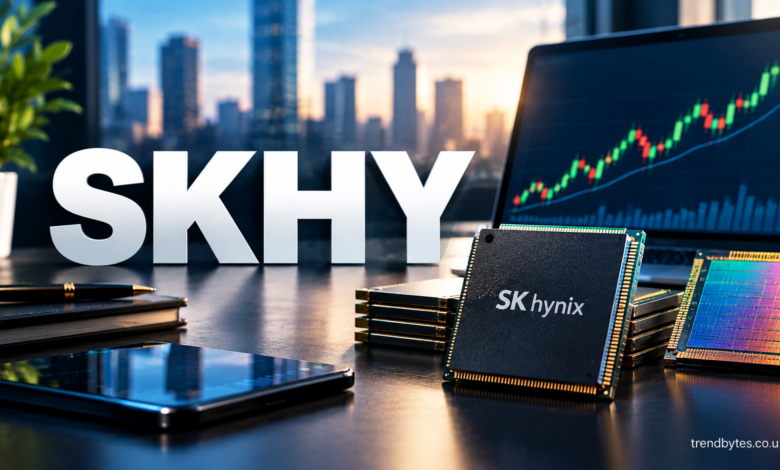
SKHY is the Nasdaq ticker for SK hynix Inc., one of the world’s leading memory-chip manufacturers and a major supplier of high-bandwidth memory used in artificial intelligence systems. The company became directly accessible to U.S. investors through its Nasdaq-listed American Depositary Receipts in July 2026, giving the stock a much larger presence in the U.S. market.
The investment story is closely tied to artificial intelligence, data centers, HBM memory, advanced DRAM, and NAND storage. SK hynix has reported record financial results in 2026, while demand for AI infrastructure continues to reshape the global semiconductor industry.
However, strong growth also creates new risks. Memory is a cyclical business, semiconductor competition is intense, and investors must consider valuation, capital spending, technology transitions, and the sustainability of AI infrastructure demand.
What Is SKHY Stock?
SKHY stock represents American Depositary Receipts of SK hynix Inc. traded on the Nasdaq.
SK hynix is a South Korean semiconductor company headquartered in Icheon. Its core products include DRAM, NAND flash, enterprise SSDs, and high-bandwidth memory.
The company’s traditional shares trade in South Korea under ticker 000660. The Nasdaq security provides U.S. investors with an easier way to gain exposure to the company during regular U.S. market hours.
One SKHY ADR represents one-tenth of an ordinary SK hynix share. This ratio is important because investors comparing the Nasdaq ADR with the South Korean-listed stock need to account for the difference in share representation.
Why SKHY Stock Matters in the AI Boom
The biggest reason investors are watching SKHY is its position in the AI memory market.
Modern AI systems require enormous amounts of data to move quickly between processors and memory. High-bandwidth memory, or HBM, is designed specifically to handle this demanding workload.
SK hynix has built a strong position in HBM and has supplied memory products to major technology customers involved in AI computing.
As AI data centers become larger and more complex, demand for high-performance memory can increase alongside demand for GPUs, AI accelerators, networking equipment, and storage.
That gives SKHY exposure to one of the most important semiconductor trends of the decade.
SKHY Stock and HBM
What Makes HBM Important?
HBM is a specialized form of memory created by stacking multiple DRAM layers and connecting them through advanced packaging technology.
Compared with conventional memory, HBM can provide much higher bandwidth while supporting the performance requirements of advanced AI accelerators.
This makes HBM a critical component in large-scale AI computing.
SK hynix began mass shipments of HBM4 in the second quarter of 2026 and planned to increase production during the second half of the year. The company also shipped samples of its next-generation HBM4E to major customers during 2026.
For SKHY investors, the transition from HBM3E to HBM4 and eventually HBM4E is particularly important because technological leadership can influence market share, pricing, margins, and customer relationships.
SKHY Stock Financial Performance in 2026
SK hynix entered 2026 with exceptionally strong financial momentum.
For full-year 2025, the company reported revenue of approximately 97.1 trillion Korean won and operating profit of about 47.2 trillion won.
The momentum accelerated in 2026.
In the second quarter of 2026, SK hynix reported approximately 79.3 trillion won in revenue and 60.5 trillion won in operating profit. Revenue increased 51% from the previous quarter, while operating profit increased 61%.
Compared with the same quarter a year earlier, revenue increased 257% and operating profit increased 557%.
Those numbers demonstrate how dramatically semiconductor profitability can change during a strong memory cycle.
The company also reported approximately 88 trillion won in cash and cash equivalents at the end of the second quarter, with total debt of about 18.6 trillion won.
For investors, the combination of strong earnings and a strengthened balance sheet gives SK hynix more flexibility to invest in future capacity.
SKHY Stock and AI Memory Demand
AI is the central growth driver behind the current SKHY investment thesis.
Large technology companies are spending heavily on data centers and AI infrastructure. Those systems require advanced processors, memory, networking equipment, and storage.
As AI models become larger and more capable, memory requirements can increase as well.
SK hynix has described this trend as a structural expansion in demand for both AI memory and conventional memory.
That distinction is important.
The company is not relying entirely on HBM. It also sells server DRAM, NAND flash, enterprise SSDs, mobile memory, graphics memory, and other semiconductor products.
This broader portfolio gives SKHY exposure to multiple areas of the memory market.
HBM4 Could Be a Major Catalyst for SKHY
HBM4 is one of the most important technologies to watch.
SK hynix reported that its HBM4 product achieved customer-required operating speeds while also targeting strong power efficiency and cost competitiveness.
The company began mass shipments in the second quarter of 2026.
The commercial success of HBM4 could matter for several reasons.
First, higher-value memory products can generate better economics than traditional commodity memory.
Second, early technology leadership can strengthen relationships with major AI chip customers.
Third, successful HBM4 production could help SK hynix defend or expand its position as competitors increase their own HBM capabilities.
Investors should therefore monitor HBM shipments, customer qualification, production yields, pricing, and the company’s ability to increase capacity without sacrificing profitability.
SKHY Stock Forecast: Bull, Base, and Bear Cases
A useful SKHY stock forecast should focus on different possible scenarios rather than a single precise price target.
Bullish SKHY Stock Scenario
The bullish case assumes AI infrastructure spending remains strong and HBM demand continues growing.
Under this scenario, SK hynix successfully ramps HBM4, maintains strong pricing, increases production capacity, and benefits from stronger demand for server DRAM and enterprise SSDs.
Higher-value products could continue supporting strong margins.
If AI spending remains elevated while memory supply remains relatively constrained, SKHY could continue producing exceptional earnings and cash flow.
Base-Case SKHY Stock Scenario
In the base case, AI demand remains healthy but growth gradually normalizes.
SK hynix continues increasing HBM shipments while conventional memory markets experience normal cycles.
Revenue and earnings could remain strong, but investors may place a greater emphasis on valuation as year-over-year comparisons become harder.
Under this scenario, stock performance could depend increasingly on whether earnings growth exceeds what investors have already priced into the shares.
Bearish SKHY Stock Scenario
The bearish scenario involves a sharper slowdown in AI infrastructure investment or a major increase in memory supply.
Memory markets are historically cyclical. When supply grows faster than demand, prices can fall rapidly.
That can cause semiconductor profits to decline even when a company continues selling large volumes of products.
A major correction in AI-related capital spending could therefore have a significant effect on SKHY.
SKHY Stock and Memory-Cycle Risk
One of the most important risks for investors is forgetting that SK hynix operates in a cyclical industry.
During periods of tight supply, memory prices can rise sharply and manufacturers can generate exceptional margins.
But semiconductor producers eventually respond by adding capacity.
If supply catches up with or exceeds demand, pricing pressure can return.
This means investors should avoid assuming that extremely high operating margins will continue indefinitely.
The right question is whether SK hynix can maintain technological leadership and attractive economics across multiple memory cycles.
SKHY Stock and NAND Growth
Although HBM receives most of the attention, NAND remains an important part of SK hynix’s business.
NAND flash is used in smartphones, computers, servers, enterprise SSDs, and other storage applications.
AI data centers are also creating demand for high-capacity and high-performance storage.
SK hynix has been expanding its advanced NAND production, including 321-layer products.
Enterprise SSD demand could become increasingly important as data centers need more storage to support growing AI workloads.
This provides another potential growth avenue for SKHY beyond HBM.
SKHY Stock and Capital Spending
Strong semiconductor demand usually requires significant investment.
SK hynix has been expanding production capacity through projects involving facilities such as M15X and the Yongin semiconductor cluster.
The company is also investing in advanced packaging and future memory technologies.
Capital spending can be positive when demand is strong because it allows a manufacturer to capture more market share.
However, investors should always ask whether new capacity is being added at the right time.
Overbuilding can create excess supply and eventually pressure memory prices.
SK hynix’s stated emphasis on capital-expenditure discipline is therefore an important factor to watch.
SKHY Stock Dividend and Shareholder Returns
SK hynix also provides shareholder returns through dividends and share-related capital allocation.
For 2025, the company announced total dividends of approximately 2.1 trillion Korean won.
In 2026, the company also announced a large share repurchase and cancellation program and indicated plans to expand shareholder returns as a percentage of free cash flow.
For investors, this creates another part of the SKHY story beyond earnings growth.
However, dividend and buyback policies can change depending on cash flow, investment needs, industry conditions, and management priorities.
Risks to Consider Before Buying SKHY
AI Spending Risk
SK hynix is benefiting from the AI infrastructure boom, but investors should not assume AI spending will grow at the same rate forever.
If major cloud companies slow capital expenditure, memory demand could eventually weaken.
Memory Price Risk
DRAM and NAND prices can be highly cyclical.
A decline in average selling prices can reduce revenue and margins quickly.
Competition
SK hynix competes with other major memory manufacturers, including Samsung Electronics and Micron Technology.
Maintaining technological leadership requires continuous research, development, manufacturing improvements, and capital investment.
Technology Transition Risk
HBM generations are evolving rapidly.
A delay in qualifying a new product or achieving strong production yields could affect customer relationships and financial results.
Valuation Risk
A company can report excellent earnings and still produce disappointing stock returns if investors have already priced in extremely high future growth.
SKHY should therefore be evaluated using earnings expectations, free cash flow, growth rates, and semiconductor-cycle assumptions.
Common Mistakes When Investing in SKHY
One mistake is treating SKHY as simply an AI stock.
It is more accurate to view it as a semiconductor and memory company with major exposure to AI.
Another mistake is assuming today’s exceptionally high margins will continue indefinitely.
Memory markets can change quickly.
Investors should also avoid comparing the Nasdaq ADR price directly with the Korean share price without considering the 1-to-10 ADR ratio.
Finally, investors should not focus only on HBM. Server DRAM, NAND, enterprise SSDs, capacity expansion, and conventional memory pricing can all affect future results.
Best Practices for Analyzing SKHY Stock
Before investing, track several indicators together.
Pay particular attention to:
- HBM market share
- HBM3E and HBM4 shipments
- HBM4E development
- DRAM prices
- NAND prices
- Enterprise SSD demand
- AI data-center spending
- Revenue growth
- Operating margin
- Free cash flow
- Capital expenditures
- Cash and debt
- Dividend payments
- Share repurchases
- Production capacity
It is also useful to compare SKHY with Samsung and Micron.
The goal is not simply to identify which company has the highest revenue. Instead, investors should compare technology leadership, HBM exposure, pricing power, production capacity, valuation, and expected earnings growth.
Is SKHY Stock a Good Investment?
SKHY could be attractive to investors who want exposure to the semiconductor industry and believe AI infrastructure spending will remain strong.
The company’s advantages include substantial HBM expertise, a broad memory portfolio, strong recent financial performance, and significant investment in future production capacity.
The Nasdaq listing also makes the company more accessible to U.S. investors.
However, SKHY remains exposed to the normal risks of semiconductor investing.
The current earnings environment could be unusually strong, and memory prices can change quickly. Investors should therefore avoid assuming that record profits automatically represent a permanent new baseline.
For long-term investors, the most important issue is whether SK hynix can maintain technological leadership as AI memory evolves.
People Also Ask About SKHY
What is SKHY stock?
SKHY is the Nasdaq ticker for SK hynix Inc.’s American Depositary Receipts. Each ADR represents one-tenth of one ordinary SK hynix share listed in South Korea.
Is SKHY the same company as SK hynix?
Yes. SKHY represents SK hynix’s Nasdaq-traded ADRs, while the company’s ordinary shares trade on the Korea Exchange under ticker 000660.
Why is SKHY stock connected to AI?
SK hynix is a major producer of high-bandwidth memory used in AI accelerators and data-center systems. Rising AI infrastructure investment can therefore increase demand for its advanced memory products.
Does SKHY pay a dividend?
SK hynix pays dividends to shareholders. U.S. ADR investors should consider the ADR structure, currency conversion, taxes, and depositary fees when evaluating the income they receive.
What is HBM4?
HBM4 is a next-generation high-bandwidth memory technology designed for demanding AI and high-performance computing applications. SK hynix began mass shipments of HBM4 in 2026.
Is SKHY a good stock for long-term investors?
SKHY may appeal to long-term investors who believe AI, data centers, and advanced memory will experience sustained growth. However, semiconductor cycles, valuation, competition, and memory pricing create meaningful risks.
What is the biggest risk for SKHY?
The biggest risk is that the current AI-driven memory boom could slow while semiconductor supply increases. Lower memory prices could then reduce the company’s exceptional profit margins.
Should investors compare SKHY with Micron and Samsung?
Yes. Comparing SK hynix with Micron and Samsung can help investors understand differences in HBM exposure, technology, memory pricing, valuation, production capacity, and competitive positioning.
Conclusion: SKHY Stock Outlook
SKHY has emerged as an important stock for investors seeking direct exposure to the AI memory market. SK hynix combines leadership in high-bandwidth memory with large businesses in DRAM, NAND, enterprise SSDs, and other semiconductor products.
Its 2026 financial performance has been exceptionally strong, supported by AI infrastructure demand and high-value memory products. The company’s HBM4 ramp, next-generation HBM4E development, advanced NAND products, and expanding production capacity could provide additional growth opportunities.
The biggest question is sustainability.
Investors need to determine whether today’s extraordinary memory demand can continue long enough to justify current expectations. They also need to monitor competition, semiconductor pricing, capital spending, and the risk of an eventual memory-cycle downturn.
For investors who believe AI infrastructure will continue expanding and that SK hynix can maintain its technological edge, SKHY offers a compelling way to participate in that trend. But the stock should still be evaluated as a cyclical semiconductor investment rather than a guaranteed AI winner.
The long-term SKHY stock outlook will ultimately depend on three things: continued AI memory demand, sustained technological leadership, and disciplined capital allocation. If SK hynix can deliver on all three, its position in the global AI semiconductor ecosystem could remain highly valuable for years to come.