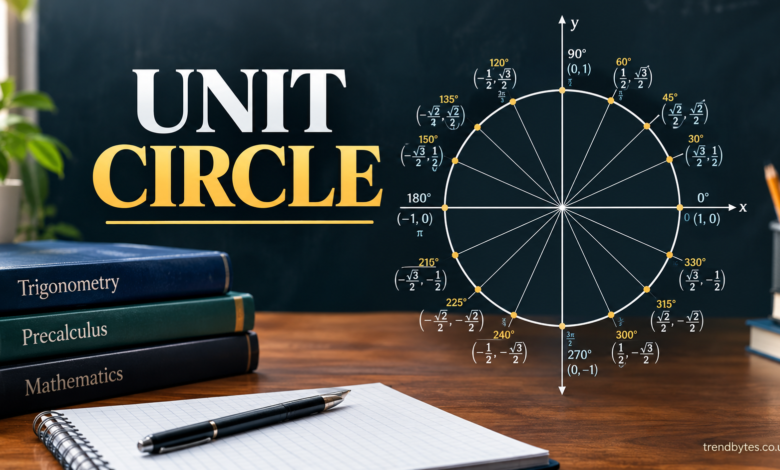
The unit circle unit circle concept is one of the most useful tools in trigonometry. If you are learning sine, cosine, tangent, radians, or special angles, understanding the unit circle can make difficult problems much easier.
Instead of memorizing dozens of separate trigonometric values, you can use one circle to find the answers. It helps explain how angles work, why sine and cosine have positive or negative signs, and how trigonometry connects to geometry.
In this guide, you’ll learn what the unit circle is, how to read it, how to memorize its values, and how to use it to solve real math problems.
What Is the Unit Circle?
A unit circle is a circle with a radius of exactly 1 unit. In the coordinate plane, its center is at the origin:
(0,0)
The standard equation of the unit circle is:
x2+y2=1
Here:
- x represents the horizontal coordinate.
- y represents the vertical coordinate.
- The radius is 1.
- The center is (0,0).
Every point on the circle is exactly 1 unit away from the center.
Why Is the Unit Circle Important?
The unit circle makes trigonometry easier because every angle connects to a point on the circle.
For an angle θ, measured from the positive x-axis, the point on the unit circle is:
(cosθ,sinθ)
This means:
cosθ=x
sinθ=y
And tangent is:
tanθ=xy
when x=0.
This simple relationship explains many of the values you use in trigonometry.
Unit Circle Unit Circle Chart: Important Angles and Values
The most useful part of the unit circle is its chart of common angles. These include 0°, 30°, 45°, 60°, and 90°, along with their equivalents in other quadrants.
Unit circle reference
Common angles in degrees and radians. The coordinates are (cos θ, sin θ).
Each point on the circle represents an angle and its cosine and sine coordinates.
Complete Unit Circle Table
| Degrees | Radians | Cosine | Sine |
|---|---|---|---|
| 0° | 0 | 1 | 0 |
| 30° | π/6 | √3/2 | 1/2 |
| 45° | π/4 | √2/2 | √2/2 |
| 60° | π/3 | 1/2 | √3/2 |
| 90° | π/2 | 0 | 1 |
| 120° | 2π/3 | −1/2 | √3/2 |
| 135° | 3π/4 | −√2/2 | √2/2 |
| 150° | 5π/6 | −√3/2 | 1/2 |
| 180° | π | −1 | 0 |
| 210° | 7π/6 | −√3/2 | −1/2 |
| 225° | 5π/4 | −√2/2 | −√2/2 |
| 240° | 4π/3 | −1/2 | −√3/2 |
| 270° | 3π/2 | 0 | −1 |
| 300° | 5π/3 | 1/2 | −√3/2 |
| 315° | 7π/4 | √2/2 | −√2/2 |
| 330° | 11π/6 | √3/2 | −1/2 |
| 360° | 2π | 1 | 0 |
The tangent value can be found by dividing sine by cosine:
tanθ=cosθsinθ
For example:
tan45∘=2/22/2=1
Understanding Degrees and Radians
Angles can be measured in degrees or radians. Both represent the same rotation, but they use different units.
A full circle equals:
360∘=2π radians
Therefore:
180∘=π radians
Common Degree-to-Radian Conversions
| Degrees | Radians |
|---|---|
| 0° | 0 |
| 30° | π/6 |
| 45° | π/4 |
| 60° | π/3 |
| 90° | π/2 |
| 180° | π |
| 270° | 3π/2 |
| 360° | 2π |
To convert degrees to radians, multiply by:
180π
For example:
60∘×180π=3π
To convert radians to degrees, multiply by:
π180
For example:
4π×π180=45∘
Expert tip: In most algebra and trigonometry classes, check whether your calculator is set to degree mode or radian mode before solving a problem.
How to Memorize the Unit Circle
Memorizing the entire table can feel overwhelming at first. Fortunately, you only need to learn a few patterns.
Step 1: Memorize the First Quadrant
The first quadrant contains the angles:
0°, 30°, 45°, 60°, and 90°.
The sine values follow this pattern:
20,21,22,23,24
The cosine values follow the same pattern in reverse:
24,23,22,21,20
This gives:
- Sine: 0, 1/2, √2/2, √3/2, 1
- Cosine: 1, √3/2, √2/2, 1/2, 0
Step 2: Use Reference Angles
A reference angle is the smallest positive angle between the terminal side of an angle and the x-axis.
For example, 150° has a reference angle of 30°.
That means:
cos150∘=−23
sin150∘=21
The values come from 30°, but the signs depend on the quadrant.
Step 3: Remember the Sign Rules
The four quadrants have different signs.
| Quadrant | Sine | Cosine | Tangent |
|---|---|---|---|
| I | Positive | Positive | Positive |
| II | Positive | Negative | Negative |
| III | Negative | Negative | Positive |
| IV | Negative | Positive | Negative |
A common memory trick is:
All Students Take Calculus
- All: Quadrant I.
- Students: Sine is positive in Quadrant II.
- Take: Tangent is positive in Quadrant III.
- Calculus: Cosine is positive in Quadrant IV.
This helps you remember which trigonometric function stays positive in each quadrant.
How to Find Any Point on the Unit Circle
The unit circle uses the coordinate formula:
(x,y)=(cosθ,sinθ)
Suppose:
θ=120∘
The reference angle is 60°. In Quadrant II, cosine is negative and sine is positive.
Therefore:
(cos120∘,sin120∘)=(−21,23)
This coordinate is the point on the unit circle at 120°.
Example: Find the Coordinates at 225°
First, identify the reference angle:
225∘−180∘=45∘
The reference angle is 45°.
The angle lies in Quadrant III, where both sine and cosine are negative.
So:
cos225∘=−22
sin225∘=−22
The coordinate is:
(−22,−22)
Finding Tangent, Secant, Cosecant, and Cotangent
The unit circle can also help you find the other trigonometric functions.
Tangent
tanθ=cosθsinθ
For 60°:
tan60∘=1/23/2=3
Secant
Secant is the reciprocal of cosine:
secθ=cosθ1
For 60°:
sec60∘=2
Cosecant
Cosecant is the reciprocal of sine:
cscθ=sinθ1
For 30°:
csc30∘=2
Cotangent
Cotangent is the reciprocal of tangent:
cotθ=tanθ1
For 45°:
cot45∘=1
Remember that division by zero is undefined. Therefore, tangent and secant are undefined when cosine is zero, while cotangent and cosecant are undefined when sine is zero.
Interactive Unit Circle Practice
Use the controls to explore common angles and their exact trigonometric values.
Explore an angle
Choose a standard angle to see its position and exact values.
45°
Cosine
√2/2
Sine
√2/2
Tangent
1
Radians
π/4
Common Unit Circle Mistakes to Avoid
Even students who understand the basic idea can make mistakes when solving problems.
1. Mixing Up Sine and Cosine
Remember:
(cosθ,sinθ)
The x-coordinate is cosine. The y-coordinate is sine.
2. Forgetting Negative Signs
The reference angle gives you the basic value, but the quadrant determines the sign.
For example, cosine is negative in Quadrants II and III.
3. Confusing Degrees and Radians
An angle of 180° is equal to π radians, not 180 radians.
Always check the angle format before using a formula.
4. Using the Wrong Calculator Mode
If your calculator is in radian mode and you enter sin(30), the answer will not be 1/2.
Use degree mode for degree angles and radian mode for radian angles.
5. Assuming Tangent Is Always Defined
Tangent is:
tanθ=cosθsinθ
When cosine is zero, tangent is undefined.
For example:
tan90∘
is undefined.
Real-World Applications of the Unit Circle
The unit circle is not just a classroom tool. It is used in many areas of mathematics, science, and technology.
Engineering and Physics
Engineers use sine and cosine to study waves, forces, and motion. For example, the movement of a swinging object can be modeled using trigonometric functions.
Computer Graphics
Video games and animation use trigonometry to rotate objects, position cameras, and calculate movement.
Sound and Light Waves
Sine waves help describe repeating patterns in sound, electricity, and other physical systems.
Navigation and Mapping
Trigonometric calculations can help determine directions, distances, and positions.
Understanding the unit circle gives you a foundation for these applications.
People Also Ask About the Unit Circle
What is the unit circle used for?
The unit circle is used to find sine, cosine, tangent, and other trigonometric values. It also helps explain radians, angles, and periodic functions.
What is the equation of the unit circle?
The equation is:
x2+y2=1
Its center is (0,0), and its radius is 1.
What are the most important unit circle angles?
The most important angles are 0°, 30°, 45°, 60°, and 90°, plus their corresponding angles in the other quadrants.
How do you memorize the unit circle quickly?
Start with the first quadrant. Memorize the sine pattern, reverse it for cosine, and then use reference angles and quadrant signs to find the remaining values.
What is the difference between sine and cosine on the unit circle?
Cosine is the x-coordinate, while sine is the y-coordinate of a point on the circle.
Why is tangent undefined at 90°?
Tangent equals sine divided by cosine. At 90°, cosine is zero, and division by zero is undefined.
Is the unit circle only used in trigonometry?
No. It is also useful in calculus, physics, engineering, computer graphics, and wave modeling.
How many radians are in a full circle?
A full circle contains:
2π radians
That is equal to 360°.
Conclusion
The unit circle unit circle concept is a key part of learning trigonometry. By understanding the radius, coordinates, reference angles, and quadrant signs, you can solve many problems without memorizing every answer separately.
Start by learning the first-quadrant values for 0°, 30°, 45°, 60°, and 90°. Then use symmetry and signs to find the remaining angles.
With regular practice, the unit circle becomes much easier to understand. Whether you are preparing for an algebra test, studying calculus, or learning how waves and motion work, mastering this circle gives you a strong mathematical foundation.